
AI Prompt Tracking: How to Monitor What AI Says About Your Brand (2026 Guide)
SEO rankings do not show what AI says about your brand. Here is how to choose prompts, which metrics to track and how often to check.

Building product experiences that make AI visibility measurable and actionable.
Your SEO dashboard tells you where your pages rank. It does not tell you what ChatGPT says when a buyer asks for the best tool in your category, or whether Google AI Mode recommends a competitor instead. AI prompt tracking fills that gap: it is rank tracking for AI answers.
TL;DR: Track 25 to 50 real buyer prompts, grouped by topic, in every AI engine your buyers use, and refresh them daily. Measure mention rate, share of voice, position in the answer, sentiment and cited sources. Our data shows why: ChatGPT, Gemini and Google AI Mode named the same first brand for only 36% of prompts, and about 30% of the brands in an answer were gone the next day. One-off checks miss most of this.
What is AI prompt tracking?
AI prompt tracking means running the same questions in AI engines on a schedule and recording, for each answer:
- whether your brand is mentioned, and which competitors are;
- in what order the brands appear;
- how the answer describes each brand (sentiment and claims);
- which sources the answer cites.
It differs from keyword tracking in three ways. There is no fixed list of ten positions, only an answer that mentions some brands and not others. The answer changes from run to run, so you measure shares and averages instead of a single rank. And the sources matter as much as the mention, because they show you what to fix.
Why it matters: AI answers disagree and change daily
We compared answers to the same prompts across ChatGPT, Gemini and Google AI Mode in SupaIntent between September 15 and October 15, 2026.
| Measure | Result |
|---|---|
| Prompts where all three engines name the same first brand | 35.9% |
| Brands from yesterday's ChatGPT answer still there today | 72.2% |
| Brands from yesterday's Google AI Mode answer still there today | 67.7% |
| Brands from yesterday's Gemini answer still there today | 65.7% |
Two conclusions. First, engines disagree: for almost two thirds of prompts, at least one engine puts a different brand first. Tracking one engine and assuming the rest is a mistake. Second, answers move: the first-mentioned brand changed from one day to the next in 23% of ChatGPT comparisons, 25% for AI Mode and 32% for Gemini. A single check is a sample of one.
The sources differ too. For the same prompts, only about a quarter of the domains Google AI Mode cites are also cited by ChatGPT, as we showed in our AI Mode tracking tools comparison.
How to choose prompts to track
Track the questions buyers ask before they buy, not your keywords. Five prompt types cover most of the journey:
| Type | Example | What it tells you |
|---|---|---|
| Best-of | "Best CRM for small business" | Whether you make the shortlist |
| Comparison | "Pipedrive vs HubSpot" | How you are positioned against a rival |
| Alternatives | "HubSpot alternatives" | Whether you win switchers |
| How-to | "How to set up a sales pipeline" | Whether AI uses you as the example |
| Review | "Is Pipedrive worth it" | What AI says about your strengths and weaknesses |
Prompt types pull different sources. In our research, review prompts cited Reddit most often and how-to prompts cited YouTube most often; see Reddit and GEO and YouTube and GEO.
How many prompts?
- 25 prompts: one product, one market. Enough to see whether you are on the shortlist.
- 50 prompts: the usual starting point, 8 to 10 per topic across 5 topics.
- 100+ prompts: several products, countries or clients.
How to track prompts by topic
Group prompts into topics (clusters) such as "brand", "discovery", "competitors" and "comparison", or by product line. Report visibility per topic, not only in total. A brand can win every brand prompt and still be missing from discovery prompts, which is where new buyers start. Keep a few branded prompts as a control and make most of the list non-branded.
Metrics to track
| Metric | How it is calculated | Decision it supports |
|---|---|---|
| Mention rate (visibility) | Answers that mention you ÷ all answers | Are you on the shortlist at all? |
| Share of voice | Your mentions ÷ mentions of all tracked brands | Who owns the category conversation? |
| Average position | Average rank of first mention, only in answers that mention you | Are you recommended first or listed last? |
| Sentiment | Positive, neutral or negative claims about your brand | Which objections AI repeats |
| Cited sources | Domains and URLs behind each answer | Which pages, reviews, threads or videos to work on |
| Engine split | Each metric per AI engine | Where to focus: ChatGPT, AI Mode, Gemini or Perplexity |
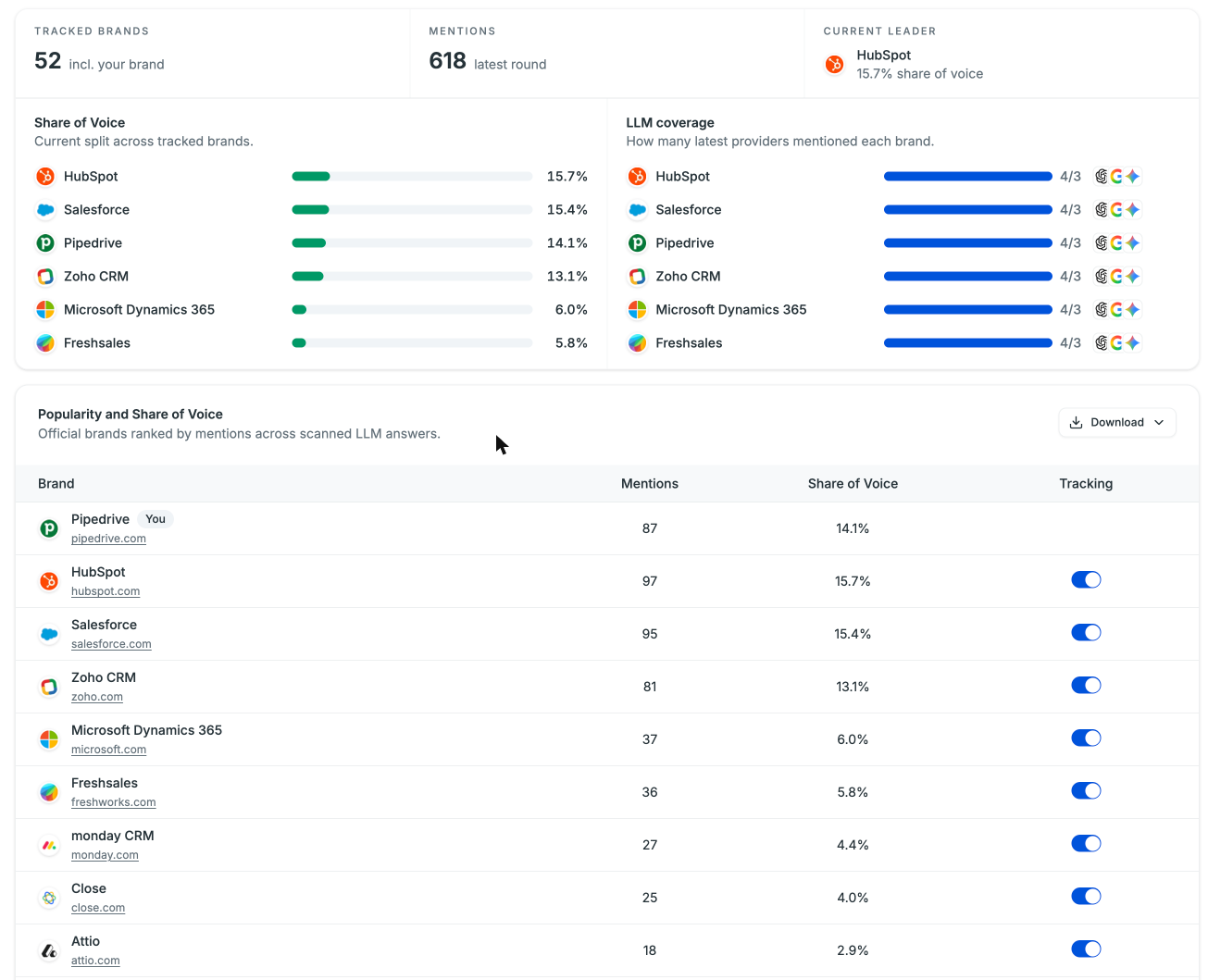
Here is share of voice in a CRM project that tracks Pipedrive against HubSpot, Salesforce and Zoho CRM. HubSpot leads with 15.7%, Pipedrive is third at 14.1%, and every leading brand is mentioned by all three engines.
How to set up AI prompt tracking: 3 ways
1. Manually
Open each AI engine in a private window, set the country, ask the prompt and write the brands, order and sources into a spreadsheet. It costs nothing and teaches you how answers look. But 50 prompts in 4 engines is 200 answers per round. Even at two minutes each, that is more than six hours, and you would need to repeat it daily to see the changes above.
2. With a script and APIs
You can call model APIs and parse the output. Keep the limits in mind: an API answer is not the same as the consumer ChatGPT interface, which searches the web and personalizes results, and Google AI Mode has no public API. You also have to build brand extraction, source parsing, storage and charts yourself.
3. With a prompt tracking tool
A tool runs your prompts in the real interfaces on a schedule and does the extraction for you. In SupaIntent the setup is:
- Add your website, competitors and buyer prompts.
- Edit the prompt list, group it into clusters and pick countries.
- Answers from ChatGPT, Google AI Mode, Gemini and Perplexity start arriving the same day and refresh daily.
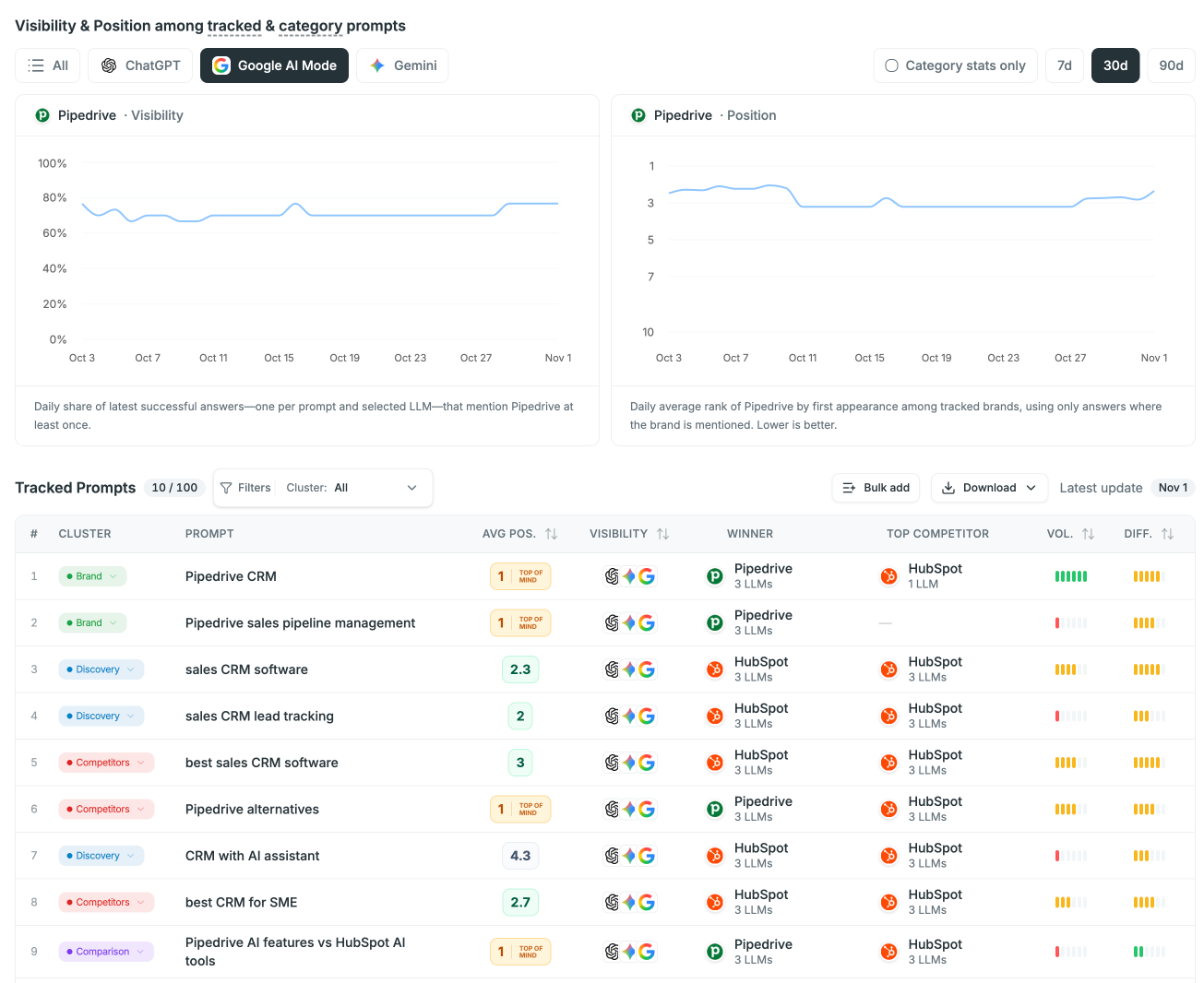
The Prompt Monitor shows visibility and position over time, then every prompt with its cluster, average position, winner and top competitor. Filter by engine to see the split. Open a prompt to read the full answer with brands highlighted.
How to see which sources AI cites for a prompt
Mentions tell you where you stand; sources tell you why. The Citations view lists every URL behind your tracked answers, grouped by domain and site type, with the engines that cited it.
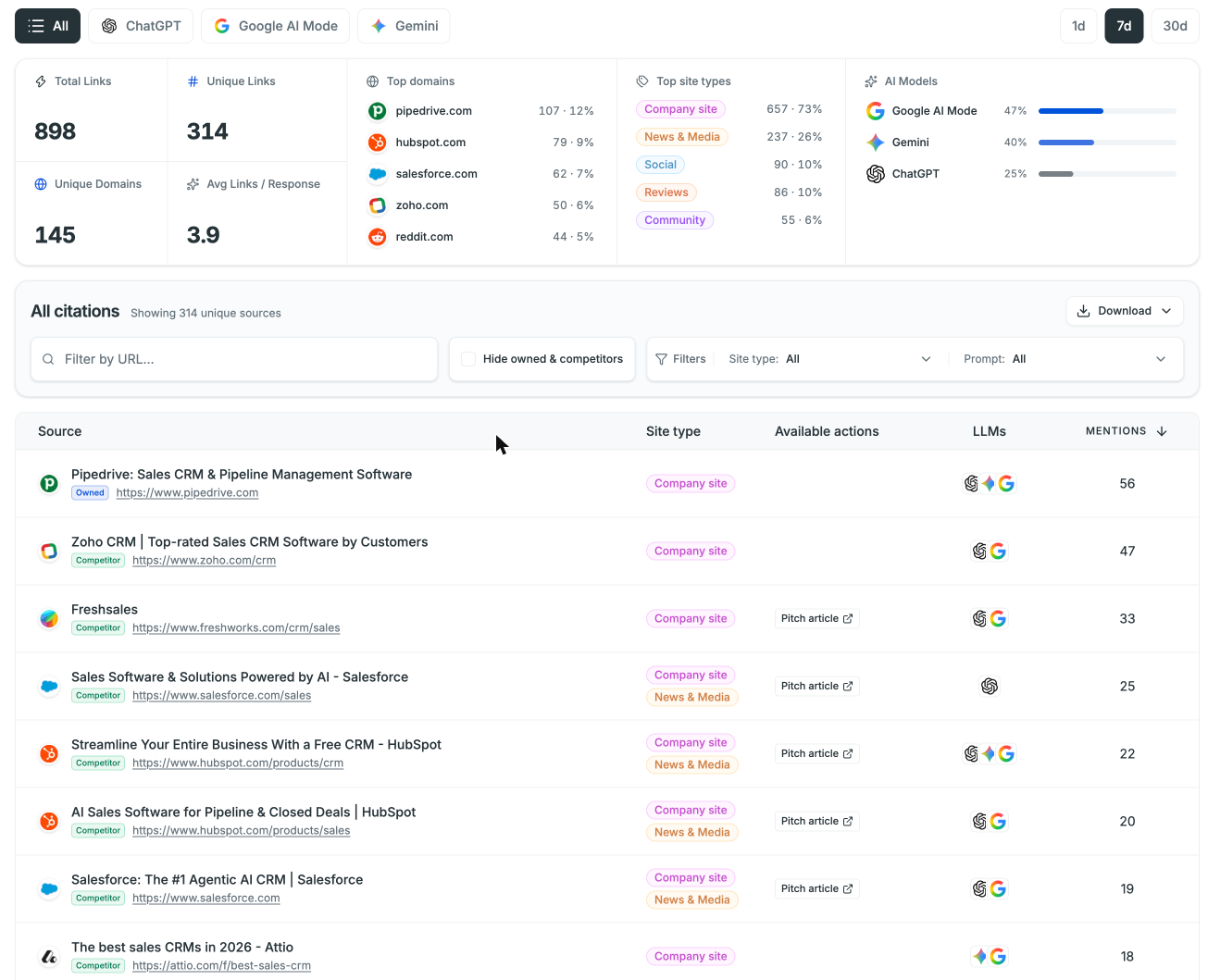
In this project, 898 citations over 7 days came from 145 domains. Company sites make up 73% of citations, news and media 26%, and reviews and communities the rest. 47% of the citations came from Google AI Mode answers, more than from any other engine. Read more in Citation Sources Analysis.
How to read the results
- You are missing from the answer. Look at the sources the answer cites. If they are review sites or listicles, get listed there. If they are competitor pages, publish a clearer page on the same question.
- You are mentioned, but late or without a link. Make your own pages easier to quote: clear category, pricing and comparison facts.
- You are mentioned negatively. Find the claim and its source. Outdated pricing or a three-year-old Reddit thread can be corrected; Reddit Radar and YouTube Radar show which threads and videos shape the answer.
For how to improve what you measure, read how to improve brand visibility in ChatGPT.
Real-time vs daily tracking
"Real-time" prompt tracking usually means a fresh run whenever you open the dashboard. That is useful for a spot check, but one run is one sample of an answer that changes daily. Daily tracking is what makes the numbers meaningful: each day adds a data point, and a 7-day or 30-day average smooths out run-to-run noise. Track daily, judge on weekly and monthly trends, and use a one-off run only to see what a buyer sees right now.
How to choose an AI prompt tracking tool
- Engines: ChatGPT, Google AI Mode, Gemini and Perplexity in the plan you pay for, not as add-ons.
- Real interfaces: answers collected the way buyers see them, not only through APIs.
- Topics and countries: clusters, per-topic reports and the markets you sell in.
- Sources with URLs: the exact pages, threads and videos behind each answer.
- Daily refresh and exports: history for trends and CSV or API for reporting.
For a vendor comparison, read best AI visibility tools. To see which domains AI cites most across categories, try our free Top AI Citation Domains tool.
Methodology
We compared brand mentions extracted from answers by ChatGPT, Gemini and Google AI Mode for prompts tracked in SupaIntent between September 15 and October 15, 2026: about 54,000 answers. Leader agreement uses 13,651 prompt-days where all three engines answered the same prompt in the same project on the same day; the leader is the brand mentioned first. Day-to-day stability compares the brands in an answer with the next day's answer to the same prompt in the same engine. Perplexity is not part of this comparison. The CRM project is shown as a tracked example; no other customer is named.
Start tracking your prompts
SupaIntent AI visibility tracking runs your buyer prompts daily in ChatGPT, Google AI Mode, Gemini and Perplexity and shows mentions, share of voice, sentiment and sources in one place. Start a 7-day free trial.
FAQ
What is AI prompt tracking?
AI prompt tracking means running the same buyer questions in AI engines such as ChatGPT, Google AI Mode, Gemini and Perplexity on a schedule, and recording which brands each answer mentions, in what order, with what tone and which sources it cites. It is rank tracking for AI answers.
How many prompts should I track?
Start with 25 to 50 prompts that a buyer would really ask, grouped into 4 to 6 topics. That is enough to see patterns per topic and per engine. Agencies and large catalogs often track 100 or more.
How often do AI answers change?
Often. In our data about 30% of the brands in yesterday's answer were gone the next day for the same prompt, and the first-mentioned brand changed in 23% to 32% of day-to-day comparisons depending on the engine. That is why daily tracking and averages over time beat one-off checks.
Can I track prompts in ChatGPT for free?
Yes, manually: ask the question in a private window, note the brands and sources, and repeat on different days. It works for a handful of prompts. Past that, manual checks take hours a week and miss day-to-day changes.
How do I see which sources AI cites for a prompt?
Use a tool that stores the cited URLs for each answer and groups them by domain and page type. In SupaIntent, the Citations view lists every source behind your tracked prompts, with the AI engines that cited it and how often.
What is the difference between prompt tracking and keyword tracking?
Keyword tracking records where your page ranks in a list of ten links. Prompt tracking records whether an AI answer mentions your brand at all, where in the answer, with what tone and based on which sources. The answer changes from run to run, so prompt tracking measures shares and averages, not a single position.




[ get started ]
Make AI Search your next revenue channel
Track and optimize visibility in ChatGPT, Gemini and other AI Search engines to drive traffic to your website that converts.