
AI Visibility Audit: A Free Checklist to Check Your Brand in ChatGPT, Gemini and Google AI
Check how ChatGPT, Gemini, Google AI and Perplexity answer your buyers' questions, in one afternoon and for free.

Helping teams improve their brand presence in AI answers.
A buyer asks ChatGPT for the best tool in your category. The answer names three competitors and not you. You will not see that in your analytics, because nobody clicked. An AI visibility audit is how you find out.
TL;DR: Write 25 to 50 buyer prompts, ask them in ChatGPT, Gemini, Google AI Mode and Perplexity, and record whether each answer names you, in which position and which pages it cites. Then check that AI crawlers can read your site and turn the gaps into three to five fixes. You can do it by hand in an afternoon with the scorecard below.
What does an AI visibility audit cover?
Five areas, in this order. Each one answers a question the next one depends on.
| Area | Question it answers |
|---|---|
| Prompts | What do our buyers ask AI before they choose? |
| Answers | Are we named, how high, and who is named instead? |
| Sources | Which pages does AI rely on when it names a competitor? |
| Technical | Can AI crawlers read the pages we want cited? |
| Plan | What do we fix first, and how will we know it worked? |
Step 1: Write buyer prompts
Audit the questions buyers ask, not your brand name. Most of your prompts should not mention you at all, because that is where AI picks the shortlist.
- Category: "best [category] for [audience]", "top [category] tools in 2026".
- Comparison: "[you] vs [competitor]", "[competitor A] or [competitor B] for [use case]".
- Alternatives: "[competitor] alternatives", "cheaper alternative to [competitor]".
- Pricing and fit: "how much does [category] cost", "is [you] worth it".
- Brand: "what is [you]", to check what AI believes about you.
25 to 50 prompts are enough for a first audit. Our guide to choosing prompts to track covers how to find the ones buyers actually use.
Step 2: Collect answers from four AI engines
One engine is not enough. They search the web differently and cite different sources: in SupaIntent data from 164,000 AI answers, only 26.5% of the domains Google AI Mode cited for a prompt were also cited by ChatGPT for the same prompt.
Ask every prompt in ChatGPT, Gemini, Google AI Mode and Perplexity, in a private window and logged out, so your history does not change the answer. For each answer, write down in a spreadsheet:
- Is your brand named? Yes or no.
- Position in the answer: first, in the list, or last.
- Which competitors are named.
- Anything AI says about you that is wrong: old pricing, missing features, a product you no longer sell.
The share of answers that name you is your mention rate. The prompts where a competitor is named and you are not are your first targets.
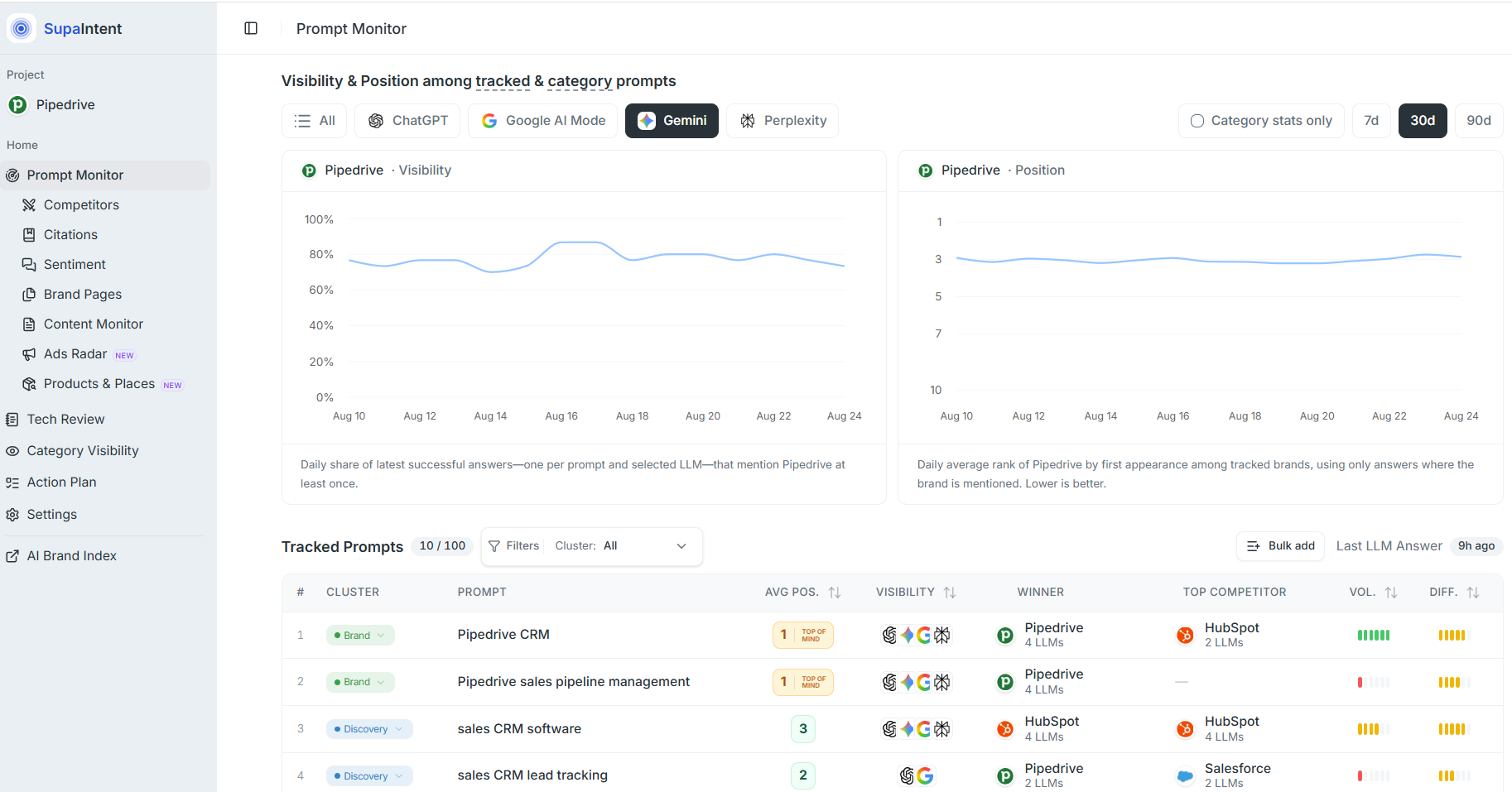
By hand, 50 prompts in four engines is 200 answers to read and record. In SupaIntent you add your site, competitors and prompts once; answers from all four engines arrive the same day, with brands, positions and the winner of every prompt extracted, and they refresh daily.
Step 3: Read the sources behind the answers
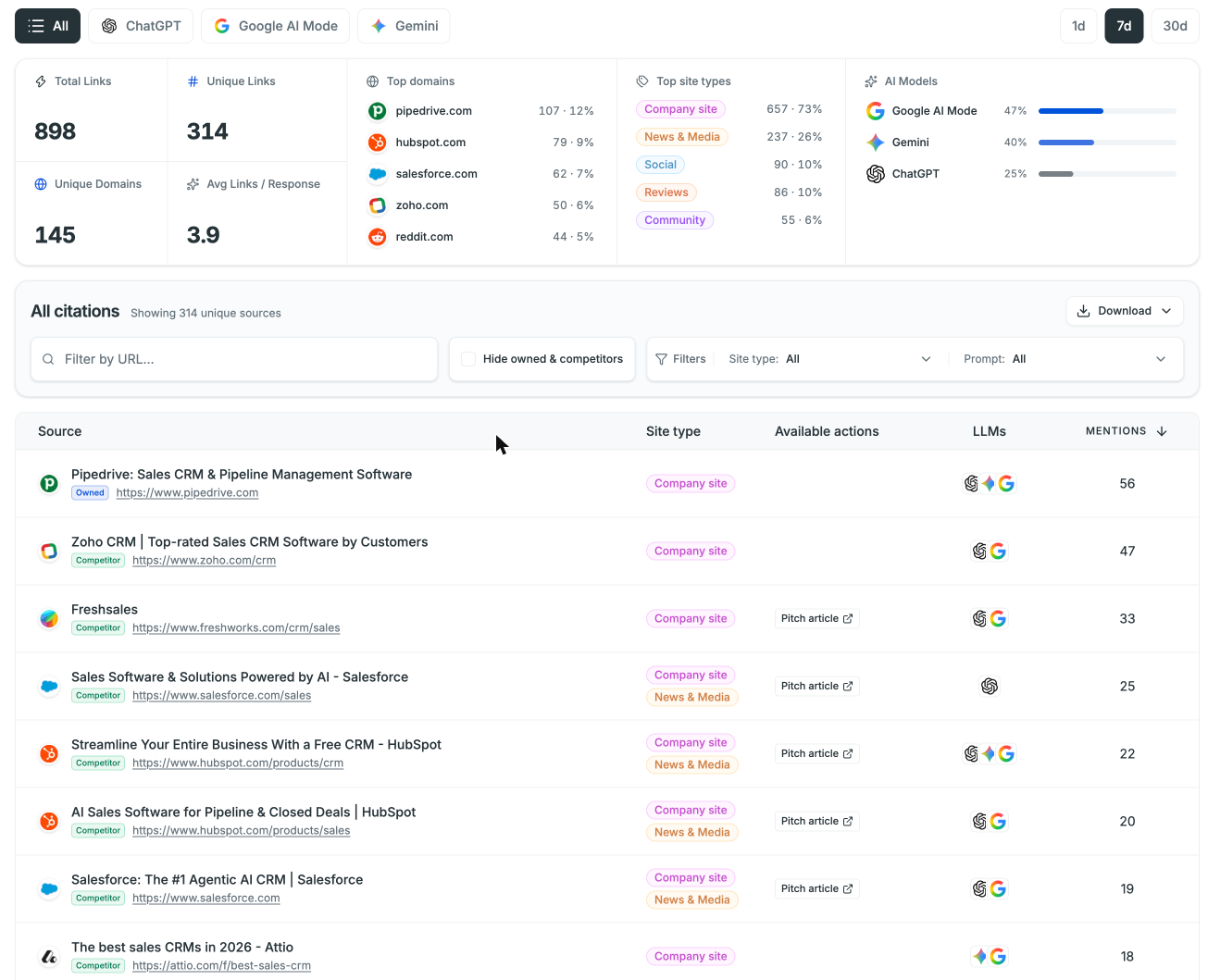
AI answers with web search are built from pages. For every prompt you lose, list the URLs the answer cites. They usually fall into a few groups:
- Competitor pages: comparisons, alternatives pages and pricing pages.
- Review sites: G2, Capterra, Trustpilot and niche directories. See which review sites AI cites.
- Listicles: "best X" articles on media and blogs.
- Community: Reddit threads and YouTube videos.
- Your own pages: note which ones AI already trusts. They are the easiest to improve.
This is the most useful part of the audit. A cited listicle that leaves you out is a concrete task: get added to it or publish a better page on the same question.
Step 4: Check that AI can read your site
If crawlers cannot read a page, it cannot be cited. Four checks catch most problems:
- robots.txt. ChatGPT search uses OAI-SearchBot; sites that block it are not shown in ChatGPT search answers. Perplexity uses PerplexityBot. Google AI Overviews and AI Mode use the normal Googlebot index: Google says there are no additional requirements beyond being indexed and eligible for a snippet. Our robots.txt guide for AI crawlers has the rules.
- HTML without JavaScript. Open a key page with JavaScript off. If the prices or product facts disappear, many AI crawlers will not see them either. See JavaScript rendering and AI crawlers.
- Titles and facts. Pricing, product and comparison pages should state plainly what you sell, to whom and for how much. See titles and descriptions for AI.
- Structured data. Organization, Product and FAQ markup help machines read the facts. See schema.org for AI.
Step 5: Turn the findings into a plan
End with three to five priorities, not a list of forty. Each priority needs its evidence: the prompt, the answer and the cited page. For example: "For 'best [category] for startups', ChatGPT and Perplexity cite a G2 category page where we have 4 reviews; ask 20 customers for reviews this month."
Then decide how you will measure progress. Record your mention rate, average position and the number of prompts you win, and repeat the same prompts next month. One answer can change tomorrow, so compare averages, not screenshots.
Audit scorecard
Tick each check as you finish it. The scorecard shows which areas are still open.
Repeat the audit without doing it by hand
The first audit tells you where you stand. The value comes from repeating it: did the fix move the answers? SupaIntent runs your prompts daily in ChatGPT, Gemini, Google AI Mode and Perplexity, stores brands, positions and cited sources, and turns the gaps into an Action Plan. Tech Review covers the crawler checks. Growth is $99/month for 50 prompts; agencies auditing clients can use White Label reports on Pro ($299/month). Agencies can also read how to sell the audit as a service.
Start a 3-day free trial and see your first audit today.
FAQ
What is an AI visibility audit?
A point-in-time check of how AI assistants answer the questions your buyers ask: whether they name your brand, in which position, which competitors they name instead and which pages they cite. It ends with a short list of fixes tied to those findings.
Can I do an AI visibility audit for free?
Yes. Ask each AI engine your buyer prompts in a private window, record the answers in a spreadsheet and run the technical checks by hand. It takes a few hours for 25 prompts in four engines. A tool becomes useful when you want to repeat the audit every week or month.
Which AI engines should the audit cover?
At least ChatGPT, Gemini, Google AI Mode or AI Overviews, and Perplexity. They use different sources: in SupaIntent data, only 26.5% of the domains Google AI Mode cited for a prompt were also cited by ChatGPT for the same prompt.
How often should I repeat the audit?
AI answers change from day to day, so a single audit is a snapshot. Repeat it monthly with the same prompts and compare averages, or track the prompts daily with a monitoring tool.
Does Google need special markup to show my site in AI Overviews?
No. Google says there are no additional requirements to appear in AI Overviews or AI Mode beyond being indexed and eligible to show a snippet in Search.



[ get started ]
Make AI Search your next revenue channel
Track and optimize visibility in ChatGPT, Gemini and other AI Search engines to drive traffic to your website that converts.