
How to Sell GEO Services: Audit, Retainer and Client Reports for SEO Agencies
Your clients already search for AEO and GEO agencies. Here is how to sell GEO as an audit, a retainer and a monthly report.

Helping teams improve their brand presence in AI answers.
Your SEO clients are starting to ask a new question: "Does ChatGPT recommend us?" If your agency cannot answer it, the client will find an agency that can. Some already are: people search for "AEO agency Miami" and "top GEO agencies in NYC" every week.
TL;DR: Sell GEO in three steps. Start with a paid AI visibility audit that shows where AI names a competitor instead of the client. Turn the findings into a monthly retainer or an add-on to the SEO retainer. Prove the work with a monthly report on mentions, position, Share of Voice and cited pages. Price it from your own delivery hours, not from market ranges nobody can verify.
Are clients already looking for GEO?
Yes, and they search for it by name. supaintent.com publishes comparisons of AEO and GEO agencies in New York, Chicago and Miami. Over four weeks, Google Search Console recorded 49 distinct searches for AEO or GEO providers that showed our pages, with 791 impressions in total. These are the largest:
| Search query | Impressions |
|---|---|
| top geo agencies in nyc | 80 |
| aeo agency miami | 66 |
| aeo agency chicago | 50 |
| aeo agency florida | 47 |
| geo services in new york | 38 |
| aeo agency long island | 26 |
| what digital marketing agencies out of nyc specialize in geo or aeo services? | 18 |
| recommend the top 10 aeo/geo agencies in the us for hospitality brands | 14 |
Data: Google Search Console for supaintent.com, October 16 to November 13, 2026. Impressions are the times our pages were shown for the query, not total search volume, which is higher. Queries with fewer than 3 impressions are not included.
Two things stand out. Buyers search by city, the same way they look for a local SEO agency. And some write the full question they would ask an assistant: "what digital marketing agencies out of nyc specialize in geo or aeo services?" If your agency sells SEO in a market and does not mention GEO, you are missing from both the search results and the AI answer to that question.
What exactly do you sell?
The client is not buying an acronym. They are buying an answer to "why does AI recommend them instead of us?" and a plan to change it. Package it as three products:
| Product | What the client gets | What your team does |
|---|---|---|
| AI visibility audit (one-off) | Which buyer questions name a competitor, which pages AI cites, what blocks the site | Picks prompts, reads answers, writes the findings and priorities |
| Monitoring and monthly report | Mentions, average position, Share of Voice and cited pages, month over month | Keeps prompts current, explains changes, sets next month's tasks |
| Optimization work | New and updated pages, review profiles, outreach to cited publishers, technical fixes | Delivers the work as scoped tasks, like SEO work today |
The third product is where most of the revenue sits, and it is work your SEO team already knows: pages, structure, links and mentions. The audit and the report make the case for it. Read how GEO and SEO overlap if your team needs the background, and see how SupaIntent supports agency GEO services.
How to run the first audit
Run the audit for an existing SEO client first. You already know the market, the competitors and the site, so you can deliver it fast and sell the retainer on real findings. The full method, with a scorecard, is in our AI visibility audit checklist.
- Write 25 to 50 buyer prompts. Use questions a buyer asks before choosing: "best [category] for [audience]", "[client] vs [competitor]", "[competitor] alternatives", "is [client] worth it". Mostly unbranded. See how to choose prompts to track.
- Collect answers from several engines. ChatGPT, Gemini, Google AI Mode and Perplexity often name different brands first, so one engine is not enough.
- Find the prompts the client loses. Mark where a competitor is named and the client is not, and where the client appears late in the answer.
- Read the cited sources. For each lost prompt, list the pages AI cites: competitor pages, review sites, listicles, Reddit threads, YouTube videos.
- Check the site. Crawler access in robots.txt, content visible in the HTML without JavaScript, titles, structured data. See the robots.txt guide for AI crawlers.
- Turn it into a plan. Three to five priorities with the evidence behind each: the prompt, the answer, the cited page.
By hand, 50 prompts in 4 engines is 200 answers to read and record. In SupaIntent you add the client's site, competitors and prompts, and answers from all four engines arrive the same day, with brands, positions and cited sources extracted.
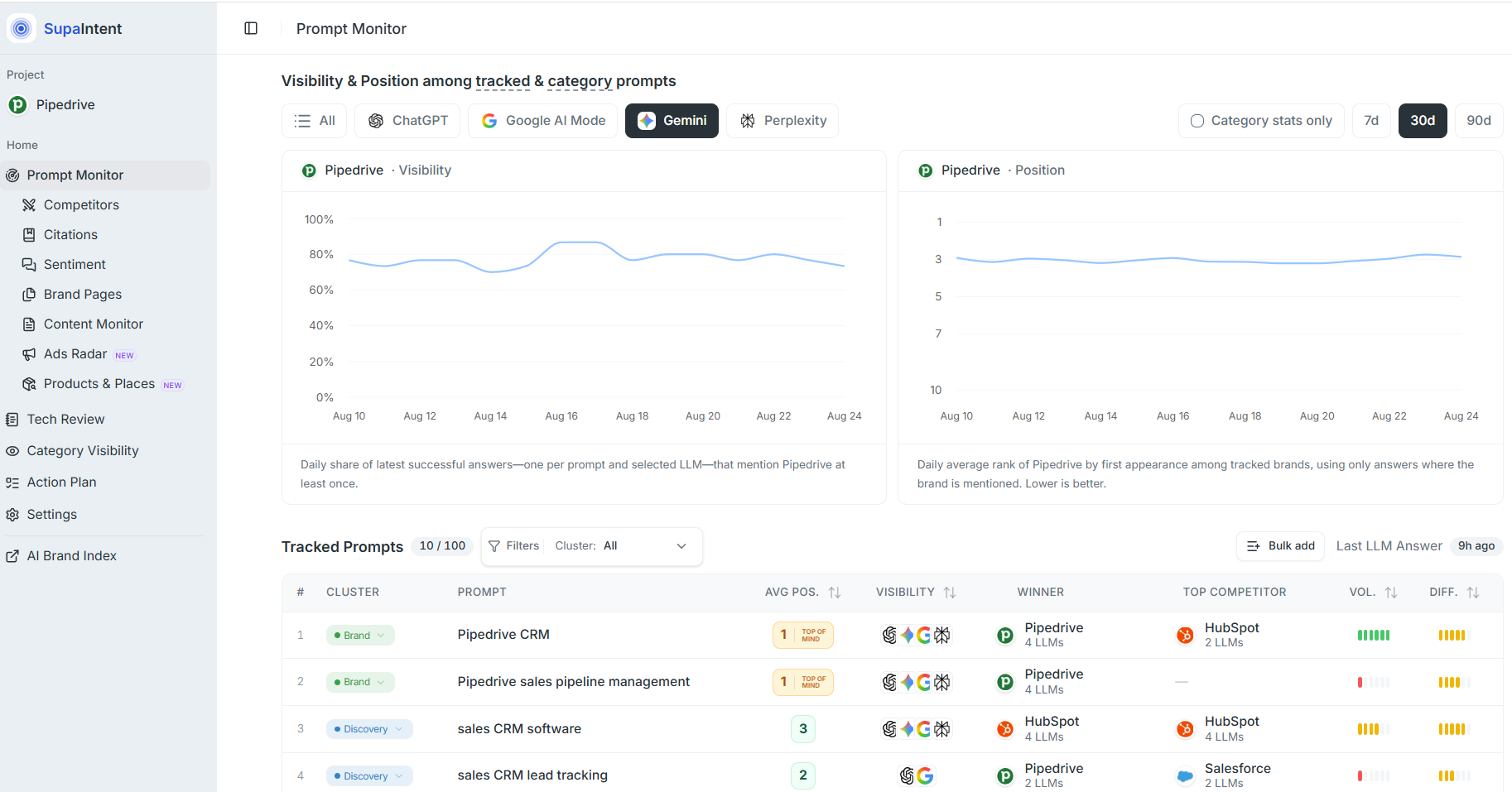
The Prompt Monitor shows the client's visibility and average position over time and every tracked prompt with its winner and top competitor. Category Analysis adds competitors you were not tracking, Citations shows the pages behind each answer, and Tech Review and Action Plan turn the gaps into a prioritized list your team can quote.
How to price it: retainer margin calculator
Search for "GEO agency pricing" and you will find retainer ranges that differ by two to five times, mostly from vendors selling the service. None of them knows your delivery cost. Start from yours: estimate the hours a client takes each month, multiply by your cost per hour, add the software and see what is left at a given fee.
- Revenue
- Delivery cost
- Margin
- Margin, %
Illustrative math, not expected earnings. Excludes sales time, overhead and taxes. SupaIntent Pro is $299/month for two client projects; larger portfolios are on Custom pricing.
A few practical rules:
- Charge for the audit. A paid audit qualifies the client and pays for the hours. Credit it against the first month if they sign the retainer.
- Sell to SEO clients first. Adding GEO to an existing retainer is easier than selling it to a stranger. Keep it a separate line in the proposal so the client sees what they pay for.
- Ask for three months. AI answers change from day to day; a quarter is the shortest period where trends mean something.
- Quote optimization separately. Monitoring and reporting are fixed; content, outreach and fixes are scoped from the audit.
How to report progress
The report is what keeps the retainer. Clients cannot see GEO work in their analytics the way they see organic traffic, so the report has to show what AI says about them and how it changed. Use the same metrics every month:
| Metric | What it answers for the client |
|---|---|
| Mention rate (visibility) | Are we named in the answers our buyers get? |
| Average position | Are we recommended first or listed last? |
| Share of Voice | How much of the conversation do we own against competitors? |
| Cited pages | Which of our pages, and which external pages, does AI rely on? |
| Sentiment | What does AI say about us, and which claims are wrong? |
Be honest about noise. The same prompt can give a different answer tomorrow, so report monthly averages per engine and topic, not single screenshots. Tie each change to the work, for example: "we published the comparison page in week 2; since then AI Mode cites it in 4 of 12 pricing prompts."
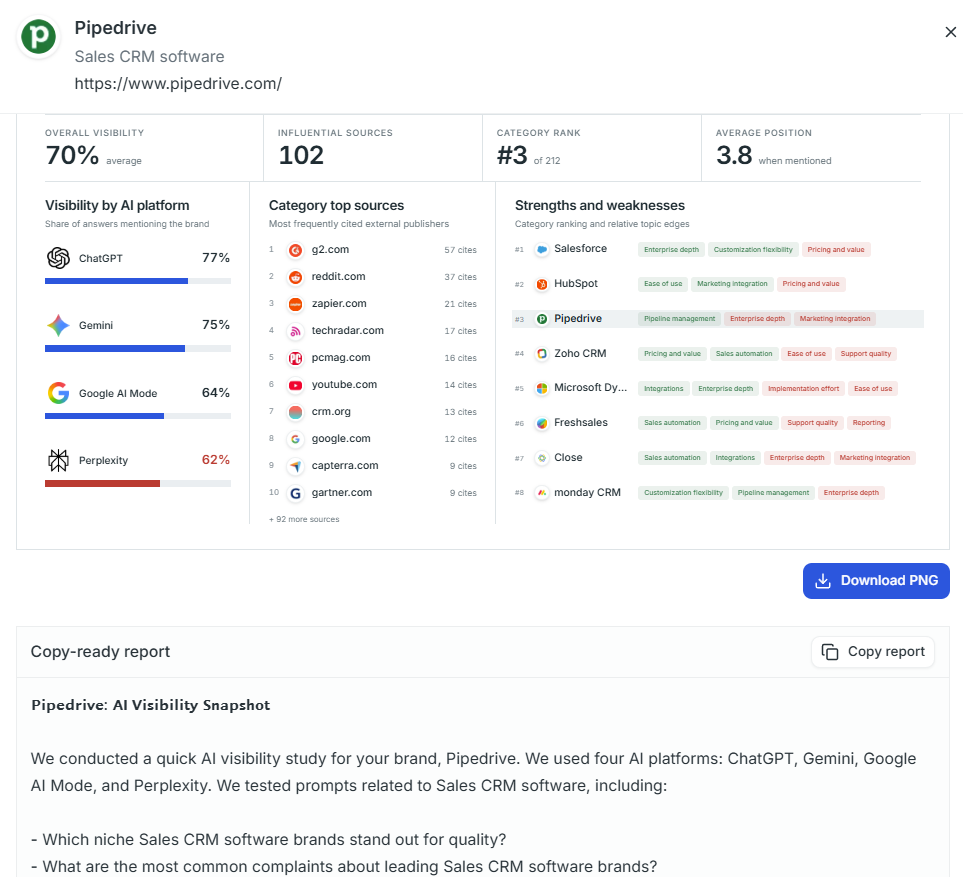
SupaIntent client reports show visibility by AI platform, category rank, perception topics and cited sources from the latest collection. White Label reports remove SupaIntent branding and export to PDF and CSV. White Label is included on Pro and Custom plans, not on Growth.
Client objections and answers
- "Isn't this just SEO?" Most of the work is. The difference is what you measure and where you look: AI answers, the sources they cite and the competitors they name. That is why it needs its own report.
- "Can you guarantee we will be recommended?" No, and nobody can. AI answers vary. What you can promise is measurement, a plan based on cited sources and monthly evidence of what changed.
- "We don't see traffic from ChatGPT in analytics." Referral traffic only counts clicks from the answer. A buyer who reads the answer and later searches the brand name shows up as branded search or direct traffic. Report visibility in answers next to branded search, not instead of it.
Start with one client
Pick one SEO client in a competitive category, run the audit, and show them the prompts where AI names a competitor. That conversation sells the retainer better than any deck.
SupaIntent Pro covers your first two clients for $299/month: 150 prompts, ChatGPT, Gemini, Google AI Mode and Perplexity, daily refresh, Action Plan, MCP and White Label reports. For a larger client portfolio, Custom pricing includes unlimited projects; book a demo. Or start a 3-day free trial and run the first audit today.
FAQ
Is GEO different from SEO?
GEO (generative engine optimization) and AEO (answer engine optimization) aim at the same thing: getting a brand named and cited in AI answers from ChatGPT, Gemini, Google AI Mode and Perplexity. Most of the work is familiar SEO work: crawlable pages, clear facts, reviews and mentions on sites AI cites. What changes is the measurement: you track whether answers name the brand and which sources they cite, not only rankings.
How much should an agency charge for GEO?
There is no reliable market benchmark yet: published ranges differ by two to five times and rarely explain their method. Price from your own delivery cost. Estimate the hours per client per month, multiply by your cost per hour, add the software, then set the fee at the margin you need. The calculator in this article does that math.
Do I need a separate tool for GEO?
For one or two prompts, manual checks in a private browser window work. For a client program you need the same buyer prompts collected daily in several AI engines, with brands, positions and cited URLs stored over time. That is what AI visibility tools such as SupaIntent do.
Can I white label GEO reports?
Yes. In SupaIntent, White Label reports without SupaIntent branding are included on the Pro plan ($299/month, two client projects) and the Custom plan, with PDF and CSV export.
How long until a client sees GEO results?
Measurement starts the day you add the prompts. Changes in AI answers depend on the work: a technical fix or a new comparison page can be picked up within weeks, while reviews and third-party mentions take longer. Agree on a three-month review with the client and report monthly trends, not single answers.




[ get started ]
Make AI Search your next revenue channel
Track and optimize visibility in ChatGPT, Gemini and other AI Search engines to drive traffic to your website that converts.