AI Visibility for Athletic Footwear Brands
A buyer asks for the right pair. AI supplies a shortlist, a reason and a few doubts. Here is how footwear leaders can understand that conversation and build a stronger case for their next sale.

Building product experiences that make AI visibility measurable and actionable.
The sale starts with the next pair
Picture a runner replacing a favourite pair. They know your name. They may even own your shoes. This time, though, they want more room in the forefoot, something comfortable for easy days, and a reason to pay for the latest version. Before visiting a store, they ask an AI assistant what to buy.
That conversation is a small act of merchandising. The assistant decides which needs matter, which brands belong together, and which compromises are acceptable. It can send the runner towards your latest release, towards a competitor, or towards last season’s discounted stock. Your advertising may have earned recognition. The recommendation still needs to earn its place.
I think this is the useful starting point for a footwear business: does the outside world understand what each part of your range is for? AI makes that question unusually easy to inspect. Its answers put brand associations, product assumptions and buying objections into words that your team can read, challenge and improve.
We reviewed saved athletic footwear answers, brand observations, topics and linked sources in  SupaIntent. The wider category includes sport, walking and lifestyle footwear; much of its detailed discussion concerns running. This guide therefore focuses on running-led brand positioning, with lessons for a broader footwear portfolio.
The first finding is practical. Performance, traction and durability lead the topic discussion in the shared category sample. Fit, use case and cushioning follow closely. Style remains visible, but the conversation gives a leadership team much more to work with than a popularity list.
The themes AI repeatedly returns to
Selected buying themes, ordered by how often they appear in saved category answers.
Longer bars mean a topic appears in more saved answers. Discussion frequency reflects this prompt set, not market demand.
Themes shown: Performance & response, Traction & durability, Fit & comfort, Use case, Cushioning, Style & design, Stability & support, Price & value, Product range, Versatility.
Editorial analysis of saved category answers, reviewed in September 2026. Brand-specific monitoring is excluded from these comparisons.
These are themes extracted from AI answers to our category questions, not a survey of shoppers. That distinction matters: a prompt about weaknesses invites a different response from a prompt about recommendations. The value is in seeing the explanations available to an assistant when it talks about your market.
The reputation attached to your logo
The same category produces markedly different conversations around different brands. In the saved sample, Nike is discussed more through performance and price than cushioning.
HOKA has a pronounced cushioning and comfort profile.
Brooks draws discussion of support, everyday use and fit.
ASICS appears across cushioning, support and durability.
These patterns describe the answers we analysed. They do not establish which company makes the best shoe, or whether a brand lacks a capability that appears less often. A distinctive shape tells you which parts of the story an assistant is currently choosing to tell.
Different brands, different conversations
Compare the themes discussed when each brand appears. Select the brands you want to explore.
Farther from the centre means a topic appears in a larger share of answers mentioning that brand. Praise and criticism both count; this is a map of discussion, not a product score.
Editorial analysis of saved category answers, reviewed in September 2026. Brand-specific monitoring is excluded from these comparisons.
Consider the commercial consequence for a broad range. A race-day reputation may help a flagship launch while doing less work for an everyday trainer. A reputation for softness can attract comfort buyers while leaving a faster product underexplained. Leadership should ask whether those associations match the products it wants to sell next.
There is a revealing tension here. One saved comparison describes Nike through racing performance. Yet the
Supwell article cited in that answer makes a different editorial judgment, emphasising its maximum-cushioning range. A citation and an AI summary can point in different directions. You have to read both.
For a smaller company, I would resist the temptation to compete for every broad “best brand” question. Start with the situation where the product has a convincing reason to exist. An exact fit preference, a terrain, a training role or a particular price decision gives the team something concrete to explain and substantiate.
You can also explore our public Shoes AI Brand Index for a broader view of the market. It is a separate benchmark covering shoes more widely; its rankings are not the source of the topic charts in this guide.
Give the recommendation a reason
Start with the run, the surface and the person
A saved comparison begins by separating runners, gym users and people looking for all-day walking comfort. Later, it explicitly advises comparing specific models. Brand-specific monitoring adds the same distinction within a single range: a saved answer about Nike discusses a rotation covering easy runs through race day. That is a sensible commercial brief for a product page: explain the task before asking someone to admire the technology.
For a running line, I would want an ordinary reader to understand its role in a week of training. Is this the pair for everyday miles, a faster session, a race, or a particular trail surface? Which alternative in your own range should they choose if their priority changes? Those distinctions should survive outside your campaign imagery.
The Nike running range and the
HOKA shoe finder are useful official starting points for exploring how brands present selection. Your task is to make the intended use just as legible wherever a buyer or reviewer encounters the product.
In SupaIntent, use Prompt Monitor to follow a stable group of buying questions. For example, a question about a first running shoe and a question about a second pair for faster sessions should remain separate. These are proposed research scenarios, not claims that our sample measures demand for either one.
Explain what the ride is meant to feel like
The clearest association in the comparison is the cushioning profile of HOKA. In a saved answer, the same discussion of softness and a smooth transition also includes caveats about how some people experience a high sole. The characteristic attracts one buyer and creates a question for another.
That is why “more cushioning” is an incomplete sales argument. Your team needs to describe the experience it designed for: the role of the shoe, the intended feel, and what distinguishes it from an adjacent model. A proprietary foam name needs an explanation that a person can use, backed by the evidence you actually have.
I would give product and marketing one shared task: write the reason a customer should choose this pair over the pair next to it. If the answer is only “our most advanced technology”, the positioning is unfinished. Explain the relevant difference and keep any measured performance claim tied to its test conditions.
Comfort needs a frame of reference
The category answers associate Brooks with predictable comfort and
New Balance with width options. The same comparative material raises narrowness as a caveat for some
Nike models. Those are AI descriptions, not a fitting assessment of a current collection. Their commercial importance is the question they leave in the buyer’s mind: will this pair suit me?
A size chart alone may not resolve that question. Ask your team to document available widths, the fit of the specific version, relevant differences from its predecessor, and the practical route to trying or exchanging it. A reviewer’s experience should retain the reviewer’s context. One person’s secure fit should not quietly become a promise of universal comfort.
Keep support language precise, too. Our saved answers sometimes stray into claims about joints and injury. We do not treat those statements as evidence of a health benefit. A footwear brand should explain its design and supported claims without borrowing medical promises from an AI answer.
The leadership question is whether the promise made before checkout matches the experience the business is prepared to stand behind. Read fit-related AI observations alongside your own customer-service and returns evidence. Those internal business records belong in your decision process; this article does not imply that SupaIntent measures your return rate.
Protect the value of the pair you are selling
A durability objection needs a model and a context
Traction and durability sit alongside performance at the top of our topic chart. The underlying material is less tidy than a single score suggests. It mixes discussion of outsole wear, upper failures, cushioning longevity and service experiences. These are different issues with different owners inside a business.
One saved risk-focused answer qualifies its criticism of high-cushioning shoes by referring to selected and early-generation models. A shortened brand summary can easily lose that qualification. For the company affected, the next step should be to identify the product and check the source before deciding whether the problem is manufacturing, expectations, old information or an unsupported generalisation.
I would make that distinction part of the review meeting. A wear complaint after a stated period of use is something to investigate. An unsourced sentence calling an entire brand unreliable is something to verify. Neither becomes a measured failure rate because an assistant repeats it.
Then put useful evidence where it can be found: the test method behind a durability statement, the product version it covers, care information and the actual warranty route. Avoid publishing a universal mileage promise simply because a competitor has one. A convincing answer respects how the shoe is used.
Last season’s shoe is part of your competitive set
One of the most useful saved value answers recommends considering previous-generation shoes. It describes Saucony through running performance for the price and
ASICS through discounted earlier models. We are not repeating its prices as current offers. The important point is the buying logic: the customer may compare your launch with an older product that already has an established review record.
For a CEO, that is a range and margin question. If the new version costs more, what changed that matters to its intended buyer? A new colour and a new campaign can be commercially valuable, but they should not have to masquerade as a performance improvement. Explain the upgrade that exists, and be clear when the earlier version remains a reasonable option.
The most useful comparison page would answer three things: who benefits from the new version, what has changed, and what has stayed familiar. This gives retail partners and reviewers a factual basis for explaining the range. It also helps your own team avoid contradictory stories about clearance stock and current products.
When an AI answer calls the brand expensive, open the surrounding passage. Is it discussing an elite racing shoe, a lifestyle release, an entry-level trainer or a service complaint? Price objections become actionable when they are attached to the choice a buyer is actually making.
Let style have a clear commercial job
Style and design appear more often than price and value in this category sample. That is a reminder that athletic footwear also carries identity. In the saved comparisons, Nike,
adidas and
New Balance cross between sport and everyday wear. The resulting discussion sometimes judges a lifestyle product through a performance lens.
My view is that a broad brand should actively manage that boundary. Describe why a lifestyle release is desirable on its own terms. Give technical footwear an equally clear account of its intended sport. When a single brand name spans both, make the line and model explicit in product pages, retailer descriptions and comparison material.
That clarity can protect the story of both businesses. It allows a customer to appreciate a design without assuming it is the right tool for every training session.
Read the evidence behind the reputation
The sources linked in our category answers include specialist reviews, retailer buying guides, broad brand lists and community discussions. They serve different purposes. A retailer can explain a selection decision; a test can describe a particular pair under stated conditions; a forum can surface an experience worth investigating. None should silently stand in for all the others.
For example, the saved answers cite the Fleet Feet brand buying guide and the
Supwell strengths-and-weaknesses article. We also found broad “worst brands” lists in risk-focused answers. Their appearance tells us what was cited, not whether every assertion deserves the same weight.
This is where a visibility report should become a working tool. In SupaIntent, the Sentiment view compares brand observations by topic and lets you open the linked evidence. You can move from a broad concern about fit or value to the actual passage that created it.
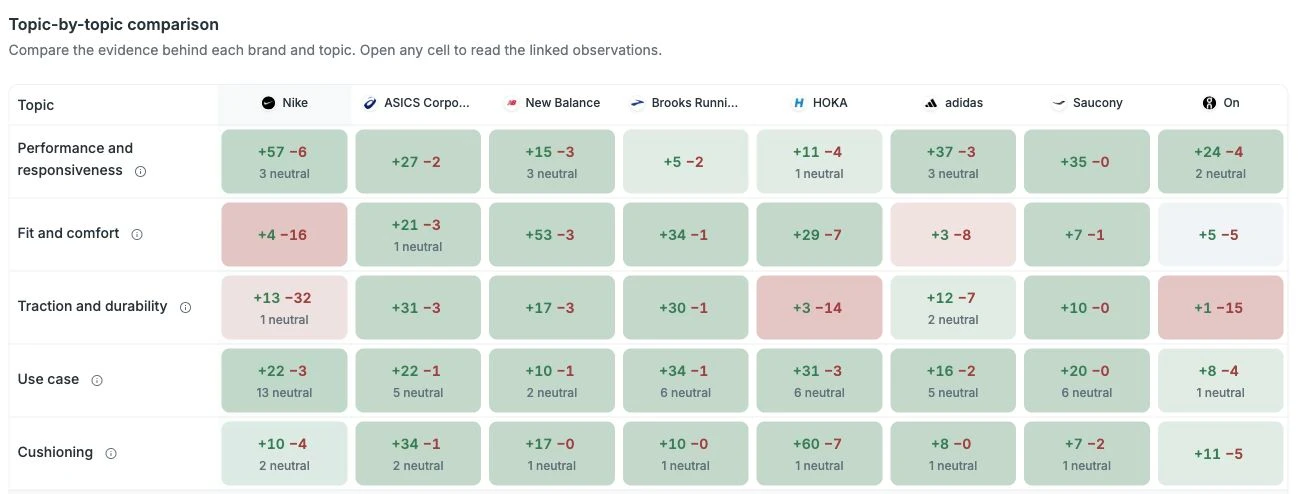
The chart can tell you where to look. The passage tells you what needs attention. Read the prompt, the answer and the linked page together. Check whether the statement concerns your brand, one product family or a particular version, and whether the source actually supports the assistant’s wording.
I would give the team four possible conclusions: correct information that needs a stronger response; outdated information that needs a current source; an ambiguous description that needs clarification; or a claim that cannot be substantiated. That is a more productive brief than simply asking for more positive mentions.
Use Citations to inspect the sources appearing in monitored answers, and Brand Pages to see which official pages are cited. If the explanation you need is missing from your own product material, improve it. If an independent reviewer raises a valid concern, the answer may require a product or service decision. Monitoring should help you tell those cases apart.
Turn the buying story into a leadership agenda
A useful first month does not require a campaign around every topic in the chart. Pick a part of the range that matters to the business, such as an everyday trainer, a specialist line or a launch whose improvement is difficult to explain. Then build a small, repeatable review around it.
- Agree on the purchase you want to understand. The commercial lead defines the intended buyer, use case, market and relevant alternatives. Include your previous version when it is a realistic substitute. Keep questions about discovery, comparison and objections distinct.
- Establish the current story. In Prompt Monitor, inspect whether the brand appears and where it enters the answer. Compare the available AI engines. In Sentiment, read the topics and passages that explain why it is recommended or questioned.
- Give each gap an owner. Product owns technical accuracy and version differences. Merchandising owns range clarity and price comparisons. Customer experience owns fitting, exchange and service information. Editorial turns approved facts into material a reader can actually use.
- Publish the smallest useful set of improvements. That might be a version comparison, a clearer fit guide or a well-supported explanation of the shoe’s intended role. Give relevant retail partners the same accurate information. A stack of near-identical articles is a poor substitute for resolving the original uncertainty.
- Review the same decisions again. Keep the monitored questions and comparison scope stable enough to interpret. Inspect changed answers and citations, including new objections. Record what the team changed so the next review has context.
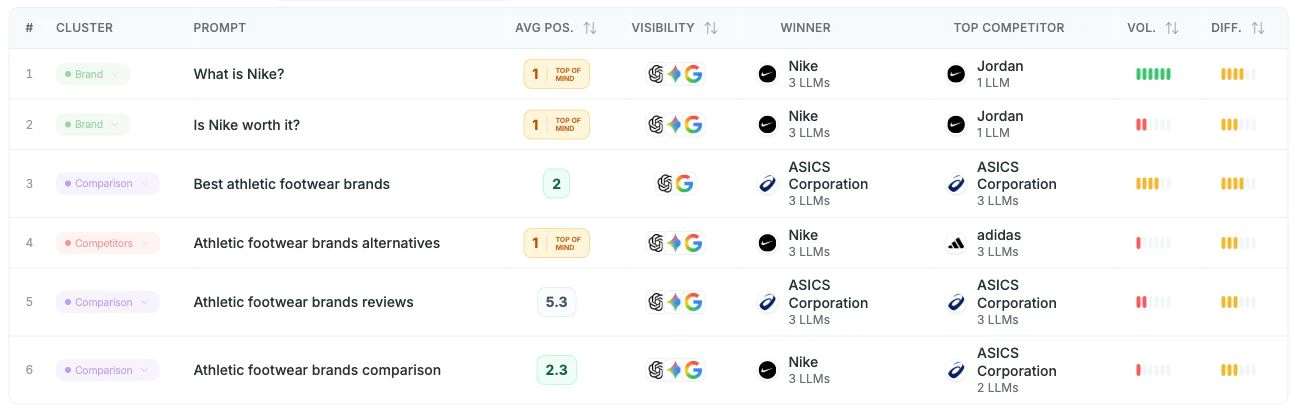
This gives a leadership meeting a concrete object: a buyer question, the current answer, the evidence behind it and the work being done. It also prevents the visibility number from becoming detached from the product the company wants people to choose.
Be disciplined about results. A changed recommendation is an observed change in an AI answer. Revenue, full-price sell-through, returns and repeat purchase belong in the business’s own measurement. Evaluate them alongside this work without claiming that one improved answer caused a sale.
SupaIntent gives your team a place to monitor those buying conversations, compare brands, examine topics and trace citations. Its role is to make the external story inspectable, so the business can decide where better information, better positioning or a better customer experience is needed.
I would want the next review to end with a sharper sentence than “we need more visibility”: this is the buyer we can serve, this is the pair that fits the job, and this is the evidence that makes the recommendation credible. That is a reason to open the product, and a reason for a customer to consider your next pair.




[ get started ]
Make AI Search your next revenue channel
Track and optimize visibility in ChatGPT, Gemini and other AI Search engines to drive traffic to your website that converts.