AI Visibility for Email Marketing Platforms
Before a demo, a buyer needs a reason to choose you. Here is what AI's email marketing conversations reveal about that reason and how to turn the evidence into a stronger commercial position.

Building product experiences that make AI visibility measurable and actionable.
The buying decision starts before your demo
Imagine a founder whose newsletter is becoming a real business. The list is growing, the bill is changing, and the team needs more than a campaign editor. Before booking a demo, she asks an AI assistant which platform can support the next stage without making email someone’s full-time technical job.
A retailer asks a different question: which platform can turn purchase history into useful follow-up? A software company wants reliable product messages alongside lifecycle campaigns. An agency wants to know what its clients can actually operate after the handover. These are illustrative buying situations, but the concerns behind them recur in the answers saved in  SupaIntent.
Each question gives the assistant permission to define the shortlist. Your company might have the right features and still be absent. Or it might appear with an explanation that attracts the wrong customer: “cheap,” when your strongest case is operational breadth; “powerful,” without explaining who can run it; “easy,” with no account of what happens when the customer becomes more sophisticated.
For the CEO of an email marketing platform, that is a positioning problem worth seeing clearly. A familiar name in an answer is useful, but a recommendation becomes commercially interesting when the reason for choosing you matches the customer you want.
The question I would put in front of a leadership team is: “When an assistant explains why someone should choose us, is it telling the story our best customers would recognise?”
My reading of the saved category answers, brand research and monitoring evidence is that email marketing has several overlapping buying conversations. Price matters, but so does the work required to get value. Automation matters, but so does the complexity it brings. Specialisation can be an advantage in one conversation and a reason to exclude a platform from another.
That gives us a more useful ambition than trying to be the universal winner. Decide which customer situations you deserve to win. Find out how AI currently describes them. Then close the gap between what your product can substantiate and what the recommendation actually says.
This is where SupaIntent belongs in the commercial process: it gives your team a way to inspect the answers, topics, competitors and sources behind that gap. The value is the next decision you can make about your positioning, your evidence, your content or an unresolved objection.
What AI keeps discussing and what it means for your business
The saved topic evidence gives us a starting point for an editorial judgement. Automation, pricing and ease of use repeatedly surface in the category conversation. Integrations, personalisation, deliverability and campaign creation help explain the differences between brands. The chart below shows selected recurring themes; it measures what these answers discuss, not what the entire market wants.
The themes AI repeatedly returns to
Selected buying themes, ordered by how often they appear in saved category answers.
Longer bars mean a topic appears in more saved answers. Discussion frequency reflects this prompt set, not market demand.
Themes shown: Email automation, Pricing model, Ease of use, Campaign creation, Platform integrations, Behavioral personalization, Audience segmentation, Email deliverability.
Editorial analysis of saved category answers, reviewed in September 2026. Brand-specific monitoring is excluded from these comparisons.
Explore email marketing brands in the AI Brand Index ↗
Pricing is a conversation about the cost of success
An email platform’s price is hard to separate from the customer’s growth. More subscribers, more sends, more sophisticated journeys and more people working in the account can all change the buying calculation. An attractive starting point answers only the first question. The customer also needs to understand what happens if the business works.
In the saved descriptions, Brevo is repeatedly associated with pricing economics, while
MailerLite often appears through affordability and accessibility. Cost also appears as an objection around
Klaviyo. These are patterns in AI’s descriptions, not a current price comparison or a verdict about value.
The commercial lesson is to make your pricing logic explainable. A useful page walks through realistic customer situations, states its assumptions and makes the boundaries visible: what changes with volume, which capabilities require a different plan, and when another approach might fit better. “Affordable” is a weak story if the reader cannot work out whether it remains true for them.
In SupaIntent, inspect the pricing-related observations and the sources behind them. If the assistant repeatedly explains your value through an outdated constraint, your team has a specific claim to investigate. If it cites the right page but still gives an incomplete explanation, the page may need a clearer account of the economics.
Automation is a promise about work someone will no longer have to do
A workflow builder is a feature. Recovering a customer after a missed purchase, welcoming a new subscriber correctly or moving a lead to the next useful message is an outcome. The distance between those two descriptions is where a buyer asks whether the platform is worth adopting.
ActiveCampaign illustrates the tension in the saved evidence: automation depth is a recurring positive association, while learning and configuration effort appear as objections. There is no contradiction. A system can be capable and require a meaningful investment of time. The unanswered question is who should make that investment.
If automation is your strength, show a complete path from trigger to result. Explain the data required, who builds the workflow, what can go wrong and how the team checks that it is working. A diagram and a real product walkthrough can explain more than a long list of automation features.
For leadership, this connects messaging with onboarding. When “too complex” keeps appearing, ask whether the evidence is old, whether the product has changed, or whether your implementation story is genuinely incomplete. Publishing another superlative cannot resolve all three possibilities.

Ease of use is part of the customer’s operating cost
The buyer of a simpler platform is often buying independence: the ability to send a campaign without asking an engineer, change a segment without a consultant, or hand over the account without creating a single point of failure. That is a serious business benefit.
MailerLite has a pronounced ease-of-use association in the saved category answers. Other observations discuss limits to sophistication. Read together, these suggest a positioning question: which team benefits most from this trade-off? They do not establish that simplicity is always better or that a particular product cannot handle a demanding use case.
If your platform serves small teams, show the everyday job from beginning to end. If it serves specialist teams, demonstrate the control those teams gain. The mistake is making both promises so broadly that the assistant has no clear customer to attach to either of them.
Integrations and personalisation are a question of fit
A wall of integration logos tells the reader that connections exist. It does not tell them whether a purchase event becomes an actionable segment, whether a change in customer behaviour arrives in time, or whether their team can explain why someone received a message.
The saved discussion around Klaviyo has a strong connection to ecommerce integrations and behavioural personalisation.
Omnisend also appears in ecommerce-oriented conversations.
Customer.io helps illustrate a different context: product and lifecycle messaging. These associations are useful precisely because they point towards different jobs.
For a platform CEO, the opportunity is to make the relevant workflow legible. Publish the chain: event, customer context, decision, message and measurement. Show the limitations as carefully as the happy path. Specific evidence gives both a human buyer and an AI answer something more useful to work with than “connect your stack.”
Deliverability is a promise that needs context
When email is part of revenue, reliability is a leadership concern. The saved evidence includes deliverability discussions, operational worries and mixed customer experiences. It does not constitute a controlled inbox-placement test, and it would be wrong to turn those observations into a technical ranking.
The useful question is what buyers are being told and whether your public explanation addresses it. How do you explain sender setup, consent, migration and support? Which responsibilities belong to the platform and which belong to the sender? What should a customer do when something goes wrong?
A recurring objection deserves investigation before amplification. Open the original answer and source, check the context, then decide whether the response belongs in documentation, onboarding, support or the product itself. Reputation work is strongest when it leads to an explanation or a fix the company can stand behind.

Audience growth changes meaning with the business model
For a creator, the newsletter may be the product. For a retailer, it supports transactions. For a software company, it supports adoption and retention. Treating all three as “email marketing users” hides the reason they choose different tools.
The saved descriptions of Kit and
beehiiv bring creator publishing, audience growth and newsletter monetisation into view. A restrained email format can be a deliberate fit for one business and a limitation for another. This is why your category story needs a customer, not just a list of capabilities.
Choose the buying situation before writing the comparison page. Then use the topic evidence to see whether AI has made the same connection or whether a competitor currently owns the explanation.
Your strongest feature can also become the objection
Look at the brands through the topics attached to them and the category stops resembling one league table. Some conversations concentrate on economics. Others concentrate on automation, ease or the data a platform can use. That is useful competitive intelligence: it reveals the explanation a buyer may encounter before your sales team gets to offer its own.
Different brands, different conversations
Compare the themes discussed when each brand appears. Select the brands you want to explore.
Farther from the centre means a topic appears in a larger share of answers mentioning that brand. Praise and criticism both count; this is a map of discussion, not a product score.
Editorial analysis of saved category answers, reviewed in September 2026. Brand-specific monitoring is excluded from these comparisons.
Select different brands in the chart. Brevo has a pronounced pricing conversation.
ActiveCampaign has a pronounced automation conversation.
MailerLite stands out around ease of use.
Klaviyo brings integrations and personalisation more strongly into the discussion. These are relative frequencies within each brand’s saved answers, including both favourable and unfavourable observations.
A larger shape does not mean a better product. A topic can appear often because a platform is praised for it, criticised for it, or compared with a rival on it. A smaller shape does not establish that a feature is missing. It may mean that this prompt set rarely brought the feature into the explanation.
My conclusion is that positioning work should start with the relationship between the promise and the objection. If your platform is described as powerful but demanding, the next useful evidence may concern implementation and time to value. If it is described as affordable but basic, the missing explanation may concern a workflow it already handles well. If it is tightly associated with one industry, you need to decide whether that focus is a commercial advantage to protect or a boundary you intend to expand.
Those are different decisions. A generic campaign to “increase AI mentions” would treat them as the same problem.
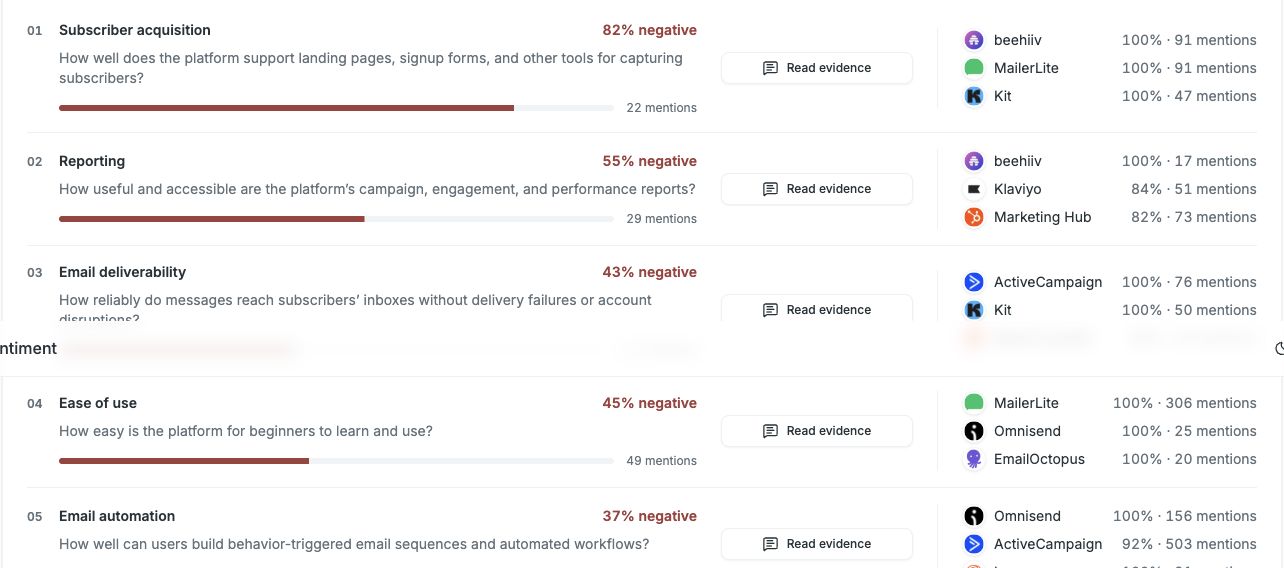 SupaIntent product view from the
 The topic comparison in the product adds the next layer: how the observations are characterised and which evidence supports them. Use the matrix to locate a question, then inspect the underlying material. A coloured cell is the start of an investigation. It should not become a claim in your sales deck without that second step.
This also keeps the response proportionate. Sometimes the problem is a missing explanation on your site. Sometimes a source is stale. Sometimes the criticism describes a real trade-off your ideal customer is willing to make. Knowing which case you are dealing with protects the team from spending a quarter trying to erase a useful specialisation.
Who gets to explain your category?
One of the most commercially revealing patterns in the saved citations is the presence of comparison articles published by the platforms themselves. The source set is not limited to independent reviewers. Competitors can participate in defining the criteria by which the category is discussed.
The saved answers cite, among other pages, an ActiveCampaign comparison guide and a
Klaviyo platform comparison. Their presence does not prove that either page caused a recommendation. It does show that a vendor’s explanation can become part of the material an assistant references.
That matters when your team debates whether to publish comparison content. The better question is what useful judgement you can contribute. A credible comparison names the customer situation, explains the criteria, acknowledges trade-offs and gives the reader enough detail to check the claims. A page that declares you the winner of every criterion has little to teach a serious buyer.
For an email platform, this might mean explaining the difference between pricing for a large, infrequently contacted list and pricing for a smaller, highly active audience. Or showing when an ecommerce workflow needs transaction data rather than a generic contact field. Or separating an attractive automation demo from the work required to maintain it.
These are editorial recommendations based on the observed themes. They are not claims that publishing a particular page will produce a particular ranking.
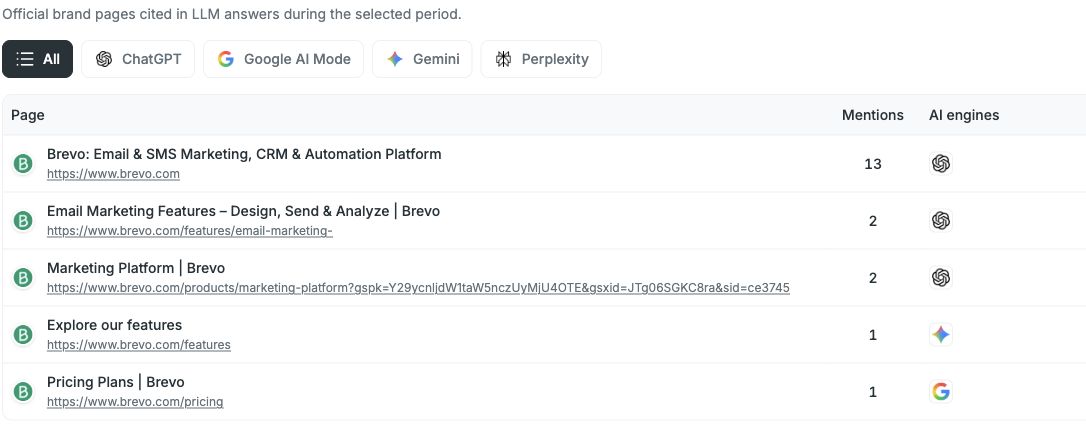 SupaIntent Brand Pages view for
 Read the evidence before deciding what it means
Different sources answer different questions. Your own pricing and documentation can explain the product precisely. Reviews can describe someone’s experience. A forum discussion can reveal the language of an objection. None should be treated as interchangeable proof.
One saved Brevo research example illustrates the danger of flattening context: a
Reddit discussion contains favourable comments about individual aspects alongside an unfavourable overall conclusion. Pulling out only the positive fragment could misrepresent the author. Treating the entire discussion as uniformly negative would also throw away useful detail.
This is why I would use Citation Intelligence and the underlying evidence before briefing a writer. Identify the actual claim, open the source, understand the situation, and decide what your company can substantiate in response. If the concern is real, route it to the team that can address it. If the explanation is incomplete, publish the missing detail. If the evidence is old, make the updated facts easy to verify.
The goal is to become a useful source on the decisions your customers are making. That takes judgement about what deserves an answer, not just a larger content calendar.
Turn the conversation into work your team can own
The reason to bring SupaIntent into this process is to turn the question “How does AI see us?” into something your team can investigate and a decision someone can own. The product provides several views of that same problem.
Start with the customer situation you want to win
Use Prompt Monitor to follow the buying questions that matter to your platform. Begin with category discovery, alternatives, pricing and features, then make room for the specific customer situations in your strategy. A broad “best platform” question can be a useful reference. It cannot stand in for every purchase decision.
For example, a platform targeting lean ecommerce teams could investigate whether the recommendation changes when the question includes a small operating team, a particular workflow or a need to migrate. Those are proposed monitoring scenarios, not additional results from this research. Their purpose is to test the position you actually intend to occupy.
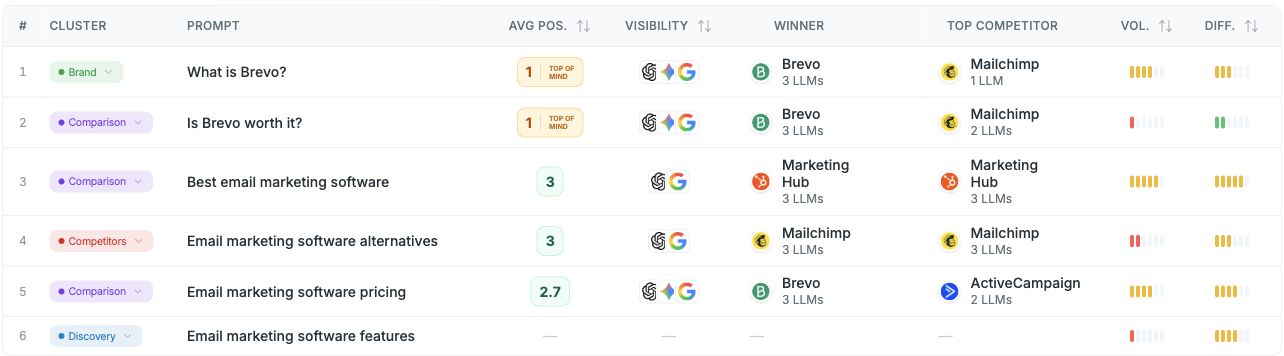 SupaIntent Prompt Monitor in the
 Separate absence from the wrong explanation
If your brand is missing, examine the competitors and the criteria in the answer. If it appears, read why. Being recommended for the wrong customer can create its own commercial friction: a misleading expectation, an unsuitable trial or a sales conversation spent undoing the initial impression.
Topic and sentiment evidence help your team explore that distinction. Content Gaps can help locate missing associations to investigate. Neither removes the need to read the answer. The important output is a precise observation, such as “our implementation story is missing from this buying situation,” rather than a vague instruction to improve awareness.
Connect the claim to its source and owner
Use Citation Intelligence to inspect the external material and Brand Pages to examine the company’s own cited URLs. Then choose a response that matches the finding. A pricing explanation belongs with someone who understands packaging. A migration concern may need customer success. A workflow gap may need product marketing working with an engineer who can verify the details.
Action Plan gives the work a place to become an explicit next step. The useful task has an owner, a concrete deliverable and a way to review it. “Write more about automation” is too loose. “Publish and verify a walkthrough of the onboarding workflow for our target customer, including the required data and setup responsibilities” is something a team can complete.
Return to the same question after the work is done
Keep the monitoring question stable enough to make the next answer interpretable. Look for changes in the explanation, the cited material, the objections and the competitors. A changed answer is an observation to examine; it is not proof that one edit caused it.
Commercial performance still needs its own measurement. AI visibility does not establish pipeline contribution, conversion or retention. Put those business measures alongside what the product shows so that a more favourable answer does not become a substitute for a better customer outcome.
What I would put on the leadership agenda
I would start with a narrow commercial choice: the customer situation the company is best equipped to serve and most wants to grow. The evidence should then help us judge whether AI describes the platform in a way that supports that choice.
In the first review, I would ask the team to bring an actual answer, the relevant topic evidence and the sources behind it. We would read them together. That small discipline prevents a dashboard summary from becoming a story that nobody has checked.
- Choose the recommendation you deserve. State the buyer, the job and the reason your platform fits. Make the claim specific enough that your product team can verify it.
- Find the gap that matters commercially. Is the brand absent, misunderstood, or associated with an unresolved objection? Decide which one is worth addressing first.
- Commission evidence, not just content. A workflow, a pricing explanation, a migration guide or a documented limitation can be more useful than another broad category article.
- Give the next review a concrete question. Revisit the same buying situation and inspect what changed. Keep your business outcomes visible alongside the AI evidence.
There is a practical philosophy behind this approach. A strong position is a promise made to a particular customer, supported by something the company can show. AI makes the quality of that explanation visible in a new place. It also exposes where a competitor has explained the problem more clearly.
SupaIntent gives your team the material to work with: the questions, the answers, the topics, the sources and the follow-up. Your advantage comes from using that material to say something more precise and more defensible about why the right customer should choose you.




[ get started ]
Make AI Search your next revenue channel
Track and optimize visibility in ChatGPT, Gemini and other AI Search engines to drive traffic to your website that converts.