
Best AI Note-Taking Apps in 2026, Ranked by What AI Recommends
The AI engines cannot agree what AI note-taking means. ChatGPT picks meeting note-takers; Google and Perplexity pick Notion and Evernote.

Helping teams improve their brand presence in AI answers.
Most AI assistants agree that Notion is the best AI note-taking app. ChatGPT does not. It picks Otter.ai, and its entire top four are meeting note-takers rather than note apps. That gap is the interesting part: the engines do not even agree on what "AI note-taking" means.
This is not a hands-on product review. It is a visibility ranking: how often, and how highly, AI assistants name each brand when a buyer asks. We pulled the numbers from SupaIntent's AI Brand Index, then sanity-checked them against what each tool actually does, so you can see both what AI recommends and where its picks hold up.
TL;DR: Notion ranks first in four of the five views, so it is the safe default. ChatGPT is the exception: it puts Otter.ai first and fills its top four with meeting note-takers (Otter.ai, Fireflies, Fathom, Granola). The category splits in two: ChatGPT treats "AI note-taking" as meeting transcription, while Google AI Mode and Perplexity treat it as personal notes (Notion, Evernote, Obsidian). Decide which kind you need first, then pick.
This ranks AI visibility, not product quality
Two things drive how often a tool appears here, and neither is hands-on quality: strong third-party coverage and long category history. A tool can lead because reviewers and directories write about it a lot, not because it is the best fit for you. We measure how AI assistants surface and rank brands, then add a category-fit note on each so a frequently named but poorly fitting tool does not get a free pass.
Rankings come from the AI Brand Index AI Note-Taking Software report, which tracks how ChatGPT, Google AI Mode, Gemini, and Perplexity rank and cite brands in this category, with position history and the source domains behind each answer. The report is live and updates over time, so treat the figures here as a snapshot from July 2026.
The AI recommendation leaderboard
The table below ranks by the all-engines view, then shows where each brand lands inside each individual engine's top results. An "n/a" means the brand did not appear in that engine's current top ten.
| # | Brand | All engines | ChatGPT | Google AI Mode | Gemini | Perplexity |
|---|---|---|---|---|---|---|
| 1 | Notion | 1 | 5 | 1 | 1 | 1 |
| 2 | Otter.ai | 2 | 1 | 5 | 5 | n/a |
| 3 | Evernote | 3 | n/a | 2 | n/a | 2 |
| 4 | Fathom | 4 | 3 | n/a | 3 | n/a |
| 5 | Fireflies.ai | 5 | 2 | n/a | 4 | n/a |
| 6 | Obsidian | 6 | n/a | 3 | n/a | 3 |
| 7 | Mem | 7 | n/a | 6 | 9 | 6 |
| 8 | Fellow | 8 | 8 | n/a | 2 | n/a |
| 9 | Granola | 9 | 4 | n/a | 6 | n/a |
| 10 | Craft | 10 | n/a | 7 | n/a | 7 |
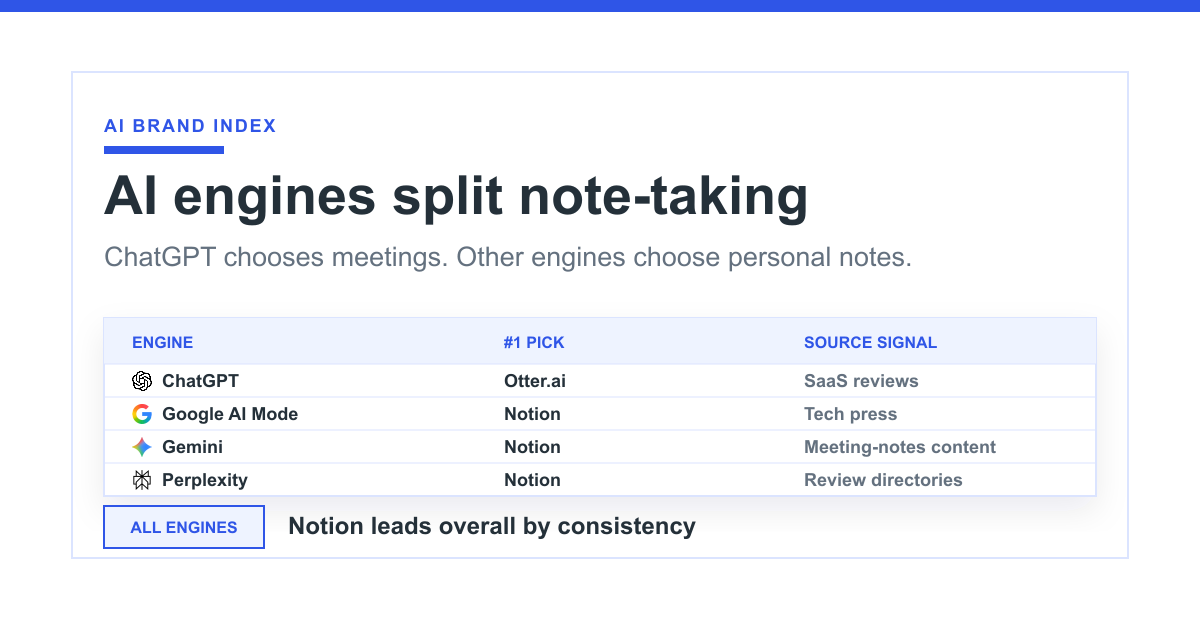
Insight: Notion is the only brand in every engine's top ten. The meeting note-takers cluster in ChatGPT and Gemini; the personal note apps cluster in Google AI Mode and Perplexity.
See the full AI Note-Taking Software report for the live snapshot and each brand's position history.
Which engine picks which leader
- ChatGPT: Otter.ai
- Google AI Mode: Notion
- Gemini: Notion
- Perplexity: Notion
- All four engines combined: Notion
Notion wins the overall view and three of the four engines. ChatGPT is the lone dissenter, and it does not just reorder the list, it swaps the whole category.
AI splits note-taking into meetings and personal notes
The clearest finding is not who ranks first. It is that the four engines disagree on what the category even is. Some of that may come from how each engine reads an ambiguous query, not a settled opinion, but the split is consistent enough to matter when you buy.
ChatGPT reads "AI note-taking" as meeting transcription: its top four are Otter.ai, Fireflies, Fathom, and Granola, all tools that record and summarize calls. Google AI Mode and Perplexity read it as personal notes: their tops are Notion, Evernote, and Obsidian, the classic knowledge apps. Gemini sits in the middle, leading with Notion but filling the rest with meeting tools like Fellow, Fathom, and Fireflies.
For a buyer, that means the "best AI note-taking app" depends on which tool you actually want. If you want to capture meetings, ChatGPT's list is the right one. For writing and organizing notes, follow Google AI Mode or Perplexity instead.
Takeaway: Work out whether you need meeting notes or personal notes before you trust any single AI shortlist. The two lists barely overlap.
The engines also trust different sources
Each engine reads different parts of the web, and that likely shapes the split. Here is where each one leaned in this snapshot.
| Engine | Sources it leans on | What that rewards |
|---|---|---|
| ChatGPT | G2, Spendhound, Techraisal (SaaS review + comparison sites) | strong software-review presence |
| Google AI Mode | Tech media: TechRadar, PCMag, ZDNet, Zapier | coverage in mainstream tech press |
| Gemini | Meeting-notes editorial: meetingnotes.com, The Digital Project Manager, vendors' own sites | niche meeting-notes content |
| Perplexity | Review directories: Capterra and G2 | classic review-directory listings |
The source diet tracks the split. Perplexity and Google lean on directories and tech press that skew toward long-established note apps, so they surface Notion and Evernote. Gemini leans on meeting-notes blogs, so it surfaces meeting tools.
A closer look at each ranked tool
Notion is the safe default across engines
Notion ranks first in the combined view and in Google AI Mode, Gemini, and Perplexity, and fifth in ChatGPT. It is an all-in-one workspace for notes, docs, and wikis with AI built in, which is why it holds up broadly. The caveat: it is a general workspace, not a dedicated meeting recorder, which is likely why ChatGPT's meeting-first list rates it lower.
Best for: teams that want notes, docs, and a wiki in one place.
Otter.ai leads ChatGPT and owns meeting transcription
Otter.ai is first in ChatGPT and fifth in Google AI Mode and Gemini, but absent from Perplexity. It transcribes meetings live and turns calls into searchable, summarized notes. Its strength is exactly what ChatGPT rewards here, and its weakness is that it does little for someone who just wants to write notes.
Best for: live meeting transcription and searchable call notes.
Evernote holds the classic personal-notes vote
Evernote ranks second in Google AI Mode and Perplexity, but does not appear in ChatGPT or Gemini. It is one of the oldest personal note apps, so review directories and tech press still name it often. That history is why the directory-led engines surface it and the meeting-led engines skip it.
Best for: straightforward personal note capture.
Fathom is a ChatGPT and Gemini meeting pick
Fathom ranks third in ChatGPT and Gemini, and is absent from Google AI Mode and Perplexity. It records video calls and writes summaries with highlights and action items. Its visibility sits squarely in the two engines that read the category as meetings.
Best for: recording and summarizing video calls.
Fireflies.ai is another meeting-first favorite
Fireflies.ai ranks second in ChatGPT and fourth in Gemini, and does not appear in Google AI Mode or Perplexity. It is an AI meeting assistant that joins calls, transcribes them, and stores the notes. Like Otter, it wins where the category is read as transcription.
Best for: automated meeting transcription across your calls.
Obsidian is the power-user knowledge base
Obsidian ranks third in Google AI Mode and Perplexity, and is absent from ChatGPT and Gemini. It is a local, markdown-based tool for building a linked knowledge base, popular with people who want control over their data. The directory-and-press engines surface it; the meeting engines do not.
Best for: power users who want a local, linked knowledge base.
Mem is the AI-first notes app in the middle
Mem appears in Google AI Mode, Gemini, and Perplexity, though never near the top. It is an AI-native personal notes app that organizes and resurfaces what you capture. Its spread-but-mid position is common for newer tools that reviewers mention without ranking highly.
Best for: an AI-first personal notes app.
Fellow is a Gemini meeting favorite
Fellow ranks second in Gemini and eighth in ChatGPT, and is absent from Google AI Mode and Perplexity. It focuses on meeting agendas, notes, and action items for teams. Its visibility is concentrated in the meeting-reading engines.
Best for: structured meeting agendas and team notes.
Granola is the newer meeting notepad
Granola ranks fourth in ChatGPT and sixth in Gemini, and is absent from Google AI Mode and Perplexity. It is an AI notepad for back-to-back meetings that listens in the background with no bot in the call. Its recent rise in coverage shows up as strong ChatGPT visibility.
Best for: note-takers in back-to-back meetings who do not want a bot joining.
Where AI names tools that may not fit
Because this is a visibility ranking, a few names surface that are not really AI note-taking tools:
- Notebloc, which Perplexity ranks ninth, is a document scanner that turns paper into PDFs, not a note app.
- ClickUp, which Gemini ranks tenth, is a project-management and work app that happens to include notes.
- GoodNotes, which Google AI Mode ranks tenth, is a handwriting and digital-paper app more than an AI note-taker.
Their presence is a reminder that AI recommendations reward web presence, not fit. Use the ranking to build a longlist, then apply your own test.
How to choose
The category splits cleanly, so start with what you actually need.
Meeting-notes picks
Follow ChatGPT's list: Otter.ai, Fireflies, Fathom, and Granola all record and summarize calls, and Fellow adds structured agendas. Pick based on your call stack (Zoom, Meet, Teams) and whether you want a bot in the meeting or a background notepad.
Personal-notes picks
Google AI Mode and Perplexity point here: Notion for an all-in-one workspace, Evernote for simple capture, Obsidian for a local linked knowledge base, and Mem for an AI-first app. Choose by how much structure and data control you want.
Where the data comes from
The rankings come from SupaIntent's AI Brand Index, a weekly snapshot of which brands ChatGPT, Gemini, Google AI Mode, and Perplexity name in each category. We merge the four engines into one ranking and track the sources behind each answer. These figures are from July 2026 and rank tools by observed position, not by a published score, and we flag names that fall outside note-taking. For the full method, see how the AI Brand Index is built.
For the broader playbook on improving those positions, see our guide to brand visibility in ChatGPT.
FAQ
What is AI note-taking software?
AI note-taking software helps you capture and organize notes with AI assistance. It splits into two kinds: meeting note-takers that record and summarize calls (like Otter.ai, Fireflies, and Fathom), and personal note apps that add AI to writing and organizing notes (like Notion, Evernote, and Obsidian).
Which AI note-taking app does AI recommend most?
Notion, in most engines. It ranks first across all engines combined and in Google AI Mode, Gemini, and Perplexity. ChatGPT is the exception and ranks Otter.ai first, because it reads the category as meeting transcription.
Why does ChatGPT recommend different tools than Google?
Because they read different sources. In this snapshot ChatGPT leaned on SaaS review sites like G2 and surfaced meeting note-takers, while Google AI Mode leaned on tech press like TechRadar and PCMag and surfaced personal note apps. Different source diets produce different shortlists.
What is the best AI app for meeting notes?
For recording and summarizing calls, the AI-recommended options are Otter.ai, Fireflies, Fathom, and Granola, with Fellow for structured agendas. Confirm which meeting platforms each supports before you commit.
Which AI app is best for personal notes?
For writing and organizing your own notes, the AI-recommended options are Notion, Evernote, Obsidian, and Mem. Choose by how much structure and data control you want.
Is this a review of the apps?
No. It measures how AI assistants rank and cite each tool, not hands-on quality. We add a category-fit note on each, but you should still test the shortlist against your own workflow.
How often does the ranking change?
AI recommendations shift as models and their sources change. The underlying AI Brand Index report updates over time and includes position history, so the current snapshot can differ from what you see here.


[ get started ]
Make AI Search your next revenue channel
Track and optimize visibility in ChatGPT, Gemini and other AI Search engines to drive traffic to your website that converts.