
Best E-Commerce Personalization Software in 2026, Ranked by What AI Recommends
The four biggest AI engines each rank e-commerce personalization brands differently. See the cross-engine data and what it means.

Helping teams improve their brand presence in AI answers.
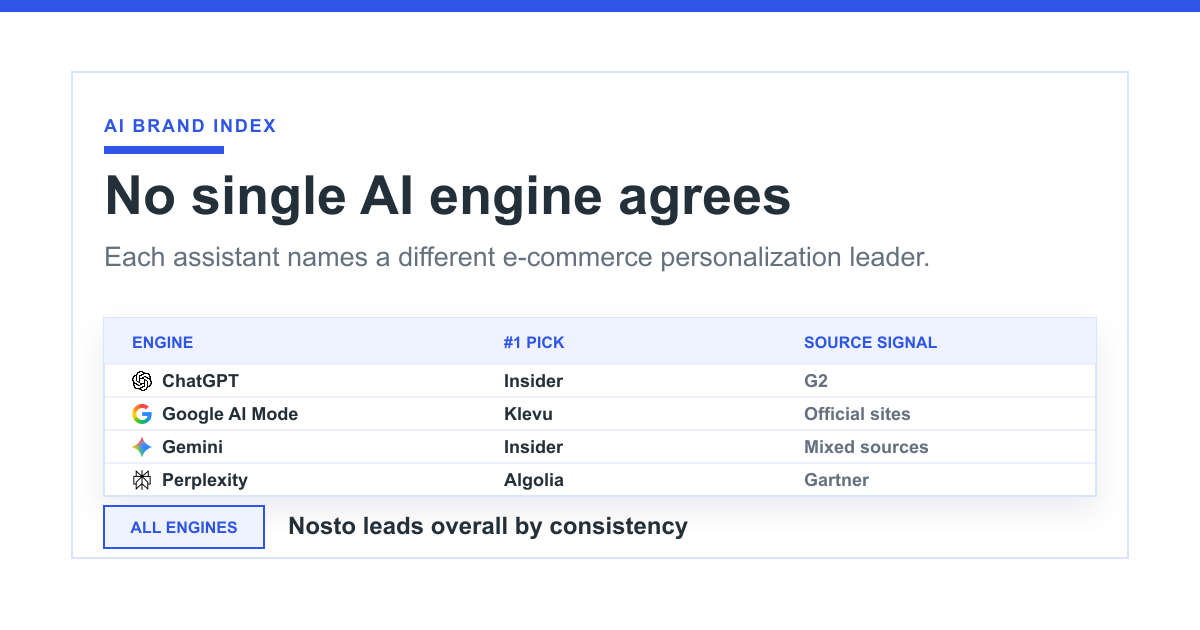
Ask an AI assistant for the best e-commerce personalization software and you will get a confident shortlist. Pose the same question to a different assistant and the shortlist changes, with a different name at the top. That is not a rounding error. In our data, the four biggest AI engines cannot agree on a leader. Insider tops two of them, Klevu and Algolia each top one more, and the brand that ranks first overall, Nosto, is not any single engine's top pick.
This is not a hands-on product review. It is a visibility ranking: how often, and how highly, AI assistants name each brand when a buyer asks. We pulled the numbers from SupaIntent's AI Brand Index, then sanity-checked them against what each vendor actually does, so you can see both what AI recommends and where its picks actually hold up.
TL;DR: There is no single "AI-recommended" leader in e-commerce personalization. Nosto ranks first overall but tops no individual engine. ChatGPT and Gemini pick Insider, Google AI Mode picks Klevu, and Perplexity picks Algolia. The engines also trust different sources: ChatGPT leans on G2, Perplexity on Gartner, and Google AI Mode on vendors' own sites. If you are buying, read across engines, not one.
This ranks AI visibility, not product quality
Two things drive how often a brand appears here, and neither is product quality: strong third-party coverage and long category history. A brand can lead because reviewers and analysts write about it a lot, not because it is the best fit for your store. We measure how AI assistants surface and rank brands, then add a market-validation note on each so a frequently named but poorly fitting tool does not get a free pass.
Rankings come from the AI Brand Index E-Commerce Personalization Software report, which tracks how ChatGPT, Google AI Mode, Gemini, and Perplexity rank and cite brands in this category, with position history and the source domains behind each answer. The report is live and updates over time, so treat the figures here as a snapshot from July 2026.
The AI recommendation leaderboard
The table below ranks by the all-engines view, then shows where each brand lands inside each individual engine's top results. An "n/a" means the brand did not appear in that engine's current top ten.
| # | Brand | All engines | ChatGPT | Google AI Mode | Gemini | Perplexity |
|---|---|---|---|---|---|---|
| 1 | Nosto | 1 | 9 | 3 | 4 | 2 |
| 2 | Dynamic Yield | 2 | 8 | 7 | 2 | 3 |
| 3 | Bloomreach | 3 | 2 | 6 | 3 | n/a |
| 4 | Insider | 4 | 1 | 10 | 1 | n/a |
| 5 | Algolia | 5 | 10 | 2 | n/a | 1 |
| 6 | AB Tasty | 6 | 3 | n/a | 8 | n/a |
| 7 | Adobe Target | 7 | n/a | n/a | 5 | 7 |
| 8 | Klevu | 8 | n/a | 1 | n/a | n/a |
| 9 | ContactPigeon | 9 | 4 | n/a | 10 | n/a |
| 10 | MoEngage | 10 | 5 | n/a | 9 | n/a |
Insight: Only two brands, Nosto and Dynamic Yield, appear in every engine's top ten. Everything else is engine-specific. A tool can top one assistant and be invisible in another.
See the full E-Commerce Personalization Software report for the live snapshot and each brand's position history.
No single engine agrees on the leader
The clearest finding is disagreement at the very top. Nosto leads the combined ranking, yet it is not the top pick in any single engine.
- ChatGPT: Insider
- Gemini: Insider
- Google AI Mode: Klevu
- Perplexity: Algolia
- All four engines combined: Nosto
ChatGPT and Gemini both put Insider first, and ChatGPT pushes Nosto down to ninth. Google AI Mode puts Klevu first, a brand that does not appear in any other engine's top ten. Perplexity leads with Algolia and does not surface Insider or Bloomreach at all in its top ten.
In practice, the "best e-commerce personalization software, according to AI" depends entirely on which AI you ask. If your buyers live in ChatGPT, Insider and Bloomreach own the conversation. Buyers who use Google's AI answers may never hear those names and will see Klevu and Algolia instead.
Takeaway: If you sell in this category, do not optimize for "AI" as one thing. Check each engine separately, because your presence in one tells you almost nothing about the others.
The engines also trust different sources
The divergence is not random. Each engine is reading different parts of the web, and that shapes who it recommends.
Here is where each one leaned in this snapshot.
| Engine | Sources it leans on | What that rewards |
|---|---|---|
| ChatGPT | G2 (g2.com and its learn subdomain) | Strong G2 review presence |
| Google AI Mode | Vendors' own official sites | A clear, well-structured official site |
| Gemini | Mixed: G2, Voyado, Bloomreach, Gartner | Broad coverage across several sources |
| Perplexity | Gartner | Analyst coverage |
In short, look at which sources an engine trusts to understand why a brand ranks where it does.
A closer look at each ranked brand
Nosto ranks first by showing up in every engine
Nosto ranks first across all engines combined and appears in every engine's top ten, which is rare here. It is a commerce personalization and customer-data platform, and its strength is breadth. The caveat is depth: ChatGPT rates it only ninth and Google AI Mode third, so it wins on consistency rather than on being any single engine's favorite.
Best for: broad, cross-engine coverage across most store types.
Dynamic Yield is the other true all-rounder
Dynamic Yield is the only other brand in every engine's top ten. It is a personalization and experience-optimization platform, now owned by Mastercard, and a long-running Leader in Gartner's Magic Quadrant for Personalization Engines. Dynamic Yield rarely tops an engine, sitting second in Gemini and third in Perplexity, but it almost never drops out, which makes it a safe shortlist name.
Best for: enterprise personalization and experimentation programs.
Bloomreach is strong everywhere except Perplexity
Bloomreach ranks second in ChatGPT and third in Gemini, and shows up in Google AI Mode, but it is absent from Perplexity's top ten. It is a large commerce experience platform combining search, merchandising, and personalization. Its one gap is Perplexity, which leans on Gartner, where Bloomreach does not currently surface.
Best for: teams that want search, merchandising, and personalization in one platform.
Insider leads in ChatGPT and Gemini
Insider is the sharpest engine-specific story. It is first in both ChatGPT and Gemini, yet only tenth in Google AI Mode and missing from Perplexity. Insider runs cross-channel customer experience and personalization. If your buyers use ChatGPT, it is effectively the default answer; in Google's AI, it barely registers.
Best for: cross-channel engagement and strong ChatGPT-era visibility.
Algolia ranks high as a search tool, not a personalization one
Algolia is first in Perplexity and second in Google AI Mode, but tenth in ChatGPT and absent from Gemini. Worth a flag: Algolia is primarily a search and discovery platform, with personalization as an add-on rather than its core. It earns AI visibility partly because search and personalization overlap in buyers' minds, so weigh it against tools built for personalization first.
Best for: search-led product discovery, with personalization as a secondary need.
AB Tasty is a ChatGPT favorite
AB Tasty ranks third in ChatGPT and eighth in Gemini, but does not appear in Google AI Mode or Perplexity. It does experimentation and personalization together, so the fit is real. Its visibility is just concentrated in a couple of engines.
Best for: teams pairing A/B testing with personalization.
Adobe Target is the enterprise name
Adobe Target appears in Gemini and Perplexity but not in ChatGPT or Google AI Mode's top ten. It is the personalization layer of Adobe Experience Cloud, aimed at large enterprises already in the Adobe stack. Its AI visibility is modest relative to its market weight, which is common for suite components that buyers research inside the parent brand.
Best for: enterprises already invested in the Adobe stack.
Klevu tops Google AI Mode alone
Klevu is the single most engine-dependent result in the set. It is first in Google AI Mode and does not appear in any other engine's top ten. The product is an AI search, discovery, and merchandising tool for e-commerce, personalization-adjacent rather than a pure personalization engine. Treat its number-one billing as a Google-specific signal, not a cross-market consensus.
Best for: AI search and merchandising on Shopify and mid-market stores.
Where AI names brands that may not fit
Because this is a visibility ranking, some names surface for reasons that have little to do with being the right personalization tool. A few are really a different category:
- Klaviyo, which Gemini ranks seventh, is an email and SMS marketing platform. It is adjacent to personalization, but not a core personalization engine.
- commercetools, in Perplexity's lower ranks, is a composable commerce platform rather than a personalization tool.
- BehavioSec, also in Perplexity, is behavioral biometrics used mainly for fraud detection, not merchandising.
Their presence looks like the model associating loosely related terms. It is a good reminder that AI recommendations reward web presence, not fit.
You will also see the same lineage listed twice. Evergage and Salesforce Interaction Studio both appear in the all-engines view, and they are the same product line that became Salesforce's personalization offering. That is an artifact of how brands are named across sources, not two separate winners.
Takeaway: Use the AI ranking to build a longlist, then apply your own fit test. If a highly ranked name does not actually do personalization for your store type, drop it.
How to read this if you are buying
Start with the two all-rounders, Nosto and Dynamic Yield, because they hold up across every engine and are less likely to be a fluke of one model's sources. Then add the engine-specific leaders that match your stack. Finally, run each candidate through a plain fit check on category, pricing, and integrations before you talk to sales.
Shopify and mid-market store picks
If you run a Shopify or mid-market store, the search-led discovery tools tend to fit fastest. Klevu leads Google AI Mode and is built for AI search and merchandising on those platforms, and Nosto gives broad personalization without heavy setup. Algolia suits you if discovery and search are the priority.
Enterprise stack picks
Larger organizations usually shortlist by existing stack. Adobe Target fits Adobe Experience Cloud shops, Dynamic Yield and Insider suit cross-channel enterprise personalization, and Bloomreach fits teams that want search, merchandising, and personalization in one platform.
How to read this if you are a vendor
Your AI visibility is not one number. In this category, a brand can be first in ChatGPT and tenth in Google AI Mode. Because each engine reads different sources, as the source breakdown above shows, the path to visibility differs by engine. If you only track one, you are flying blind on the others.
That is the gap SupaIntent measures. It tracks how AI assistants rank, describe, and cite your brand across engines over time, so you can see where you are winning, where you are missing, and which sources are shaping the answer. If you want to understand and improve how AI recommends your brand, that is the place to start.
Where the data comes from
The rankings come from SupaIntent's AI Brand Index, a weekly snapshot of which brands ChatGPT, Gemini, Google AI Mode, and Perplexity name in each category. We merge the four engines into one ranking and track the sources behind each answer. These figures are from July 2026 and rank brands by observed position, not by a published score, and we flag names that fall outside on-site personalization. For the full method, see how the AI Brand Index is built.
FAQ
What is e-commerce personalization software?
E-commerce personalization software tailors what a shopper sees, such as product recommendations, search results, content, and offers, based on their behavior and profile. Tools in this category range from dedicated personalization engines like Nosto and Dynamic Yield to search-led platforms like Algolia and Klevu that add personalization on top of discovery.
Which e-commerce personalization software does AI recommend most?
It depends on the engine. Across all engines combined, Nosto ranks first, though it tops no single engine. ChatGPT and Gemini put Insider first, Google AI Mode picks Klevu, and Perplexity picks Algolia. Nosto and Dynamic Yield are the only two brands that appear in every engine's top ten.
Why do ChatGPT and Google give different answers?
Because they read different sources. In this snapshot, ChatGPT's answers leaned almost entirely on G2 reviews, while Google AI Mode mostly cited vendors' own official sites and Perplexity leaned on Gartner. Different source diets produce different shortlists.
What is the best ecommerce personalization software for small businesses?
This ranking measures AI visibility, not price, so treat it as a shortlist rather than a spend guide. For smaller and Shopify-based stores, the search-led tools tend to fit fastest: Klevu leads Google AI Mode and is built for AI search and merchandising, and Nosto offers broad personalization without heavy setup. Always confirm pricing and integrations directly, since those are not part of this data.
Is this a review of the products?
No. It measures how AI assistants rank and cite each brand, not hands-on product quality. We add a market-validation note on each brand, but you should still run your own fit check on features, pricing, and integrations.
How often does the ranking change?
AI recommendations shift as models and their sources change. The underlying AI Brand Index report updates over time and includes position history, so the current snapshot can differ from what you see here.
What should a vendor do to rank better in AI answers?
Track each engine separately, then strengthen the sources that engine trusts. Strong G2 presence tends to help in ChatGPT, Gartner coverage in Perplexity, and a clean, well-structured official site in Google AI Mode.




[ get started ]
Make AI Search your next revenue channel
Track and optimize visibility in ChatGPT, Gemini and other AI Search engines to drive traffic to your website that converts.