SupaIntent vs AthenaHQ: Features and Pricing
Bring buyer questions, 20 prepared category questions, topic evidence and practical priorities into your research. SupaIntent Growth starts at $99/month.

Building product experiences that make AI visibility measurable and actionable.
The problem both tools solve
Your team has a list of questions buyers ask before choosing a vendor. You want to see whether AI recommends your brand, which competitors appear and what the answers say about your product.
 SupaIntent and
 AthenaHQ both help investigate that position through brand monitoring and cited sources. AthenaHQ also offers sentiment and content agents, as described in AI Peekaboo’s review.
The first buying question is practical: how much should an ongoing paid research program cost? SupaIntent Growth gives you 50 monitored prompts for $99/month. That is a lower paid starting budget than AthenaHQ Starter.
A lower paid starting budget
Executive takeaway: start paid monitoring below $100/month. AthenaHQ Starter is $295/month with 3,600 response credits, as documented in EchoWi’s review. SupaIntent Growth starts at $99, with its allowance expressed in tracked prompts.
| Buying criterion | SupaIntent | AthenaHQ |
|---|---|---|
| Monthly paid entry price | $99/monthGrowth. | $295/monthStarter; free evaluation also exists. |
| Included monitoring allowance | 50 tracked promptsGrowth prompt allowance. | 3,600 response creditsStarter response allowance; different billing unit. |
| Brand and competitor monitoring | YesCompare visibility and positions over time. | YesTracks brands across AI responses. |
| Citation analysis | YesFilter sources and open their related answers. | YesTracks sources cited in AI answers. |
The price advantage matters when your team is establishing its first useful question panel. You can start within a smaller recurring budget and use the evidence to decide which themes deserve more attention.
Prompts and response credits
Our Growth plan includes 50 prompts for $99/month. Compared with AthenaHQ Starter at $295, that is a $196 lower monthly paid entry. AthenaHQ also offers a free Essential evaluation with 300 credits. You can try that product without buying Starter.
The packages use different units. A prompt is a question you track; a response credit pays for an individual collected AI response. In AthenaHQ’s model, one credit equals one response. When planning a program, account for how many questions, engines and collection days it needs.
Our advantage is the lower starting subscription cost. The different billing units do not establish which platform offers more monitoring. Compare your required engine set and collection scope before choosing a package. These figures cover monthly subscriptions, excluding annual discounts, taxes and negotiated terms.
Build a useful buyer-question panel
SupaIntent combines your own buyer questions with category research, topic-level evidence and practical priorities. Your team can investigate a brand’s position from several angles before choosing what to change.
Build the research around your market
Consider an illustrative software team preparing its next positioning review. Instead of tracking only its name, it groups buyer questions around implementation, price, integrations and alternatives. In Prompt Monitor, track your own questions in  ChatGPT,
  Google AI Mode and
  Gemini. Add prompts in bulk, organize them into thematic groups and expand your list with suggestions drawn from collected answers. Each question shows brand visibility, average position, trends, the leading brand and the main competitor. Open its full answer history with mentions and sources.
The project also has a prepared set of 20 category questions. Choose which of those questions to include in project statistics. Category Visibility provides a separate regular comparison of brands in the category, with mentions, positions, trends and sources.
Compare visibility and brand positions across periods, providers and prompts. Competitor analytics shows automatically discovered brands, mention counts, average positions and Share of Voice, with details by prompt and AI service; you can exclude an irrelevant competitor from the analysis while retaining its historical data.
Find the theme and read its evidence
When a competitor leads on implementation questions, open Content Gaps and read the supporting responses. Check the topic sentiment matrix for the descriptions associated with your brand. Then inspect the pages cited alongside those descriptions.
Positive, negative and neutral assessments are attached to themes, with a brand/topic matrix, history and supporting answer fragments. Content Gaps shows both competitor-led themes and themes where your own brand leads. Your team can address a concern while keeping the messages that already stand out.
Follow the page your team chooses to improve
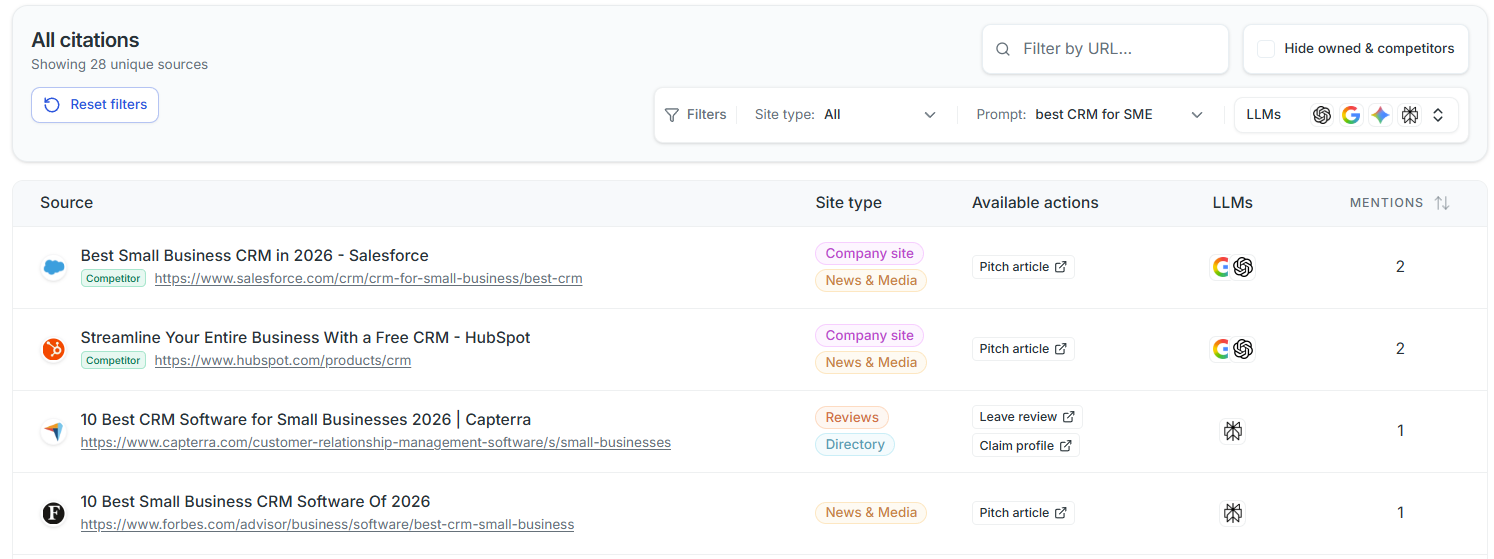
Brand Pages shows citations to pages of your own website. Add an important guide or comparison URL to Content Monitor to follow its appearance among the sources of collected answers. Content Monitor accepts links to your own or external publications. Compare citation frequency, answer coverage and source types across your own and competing sites. Filter citations by period, provider, prompt group, individual prompt or source, and export them in CSV or Excel.
The next task might be a clearer setup guide, a correction to a recurring claim or a stronger presence on an influential source. Action Plan helps prioritize those issues. Tech Review checks robot access, robots.txt, sitemaps, llms.txt, content in HTML, structure, semantics, metadata and company information. Its overall score, scores by area, problems, recommendations and change history help your team make a concrete technical brief.
Ask the built-in project chat which period changed or which answers support a concern. Save, continue or archive conversations as your work develops. On Pro, MCP lets an external agent read project metrics, compare periods and retrieve evidence. On Pro, Ads Radar shows advertisers, ad content and links, with filters by service and prompt, placement trends and leading advertisers’ share of observed ads. Products & Places shows product and location cards from project and category answers, with images, links and available attributes; search, filter and sort them for your review.
Investigate Reddit, YouTube and review sources
SupaIntent gives you dedicated views of the communities, videos and review pages cited in AI answers. Use them to identify the discussions and publishers your team should read before choosing where to contribute, update information or explain your product.
Reddit Radar: find the conversations AI draws on
See the most-cited communities and discussions, how often they appear, which AI services cite them and which brands appear in the associated answers. Reddit Radar also separates external sources that explicitly mention Reddit. Your team can follow a recurring concern to a specific discussion and decide whether it deserves attention.
YouTube Radar: identify the videos behind recommendations
Find leading cited channels and videos, with citation frequency and the share of collected answers that cite YouTube. Inspect available publication dates, duration, views, likes, comments and channel subscriber counts. These details help your team assess the cited material and choose which product explanation or demonstration to investigate.
Review Radar: inspect the pages shaping the shortlist
Explore cited sources from platforms such as G2, Trustpilot, Capterra, Clutch, Gartner Peer Insights and Tripadvisor. Review Radar ranks platforms by citation frequency and brands by their presence in answers containing review-platform links. Inspect specific pages, separated into profiles, categories, comparisons, reviews and complaints, then open the supporting AI answers. This gives your team a concrete source to assess when reviewing its positioning or reputation.
Choose SupaIntent
Choose SupaIntent for buyer-question monitoring, category research, topic evidence and an Action Plan grounded in your project. Growth gives your team a 50-prompt starting point at $99/month for that ongoing investigation.
Sources and scope
Checked in September 2026. EchoWi documents Starter pricing and response credits; AI Peekaboo describes the monitoring, sentiment and content workflow. We checked current pricing and the free evaluation directly.
This comparison is authored by SupaIntent. Review publishers sell competing products or services. Our claims cover customer capabilities, excluding Beta and internal tools, with module access dependent on subscription. The workflow example is illustrative. We compare the paid starting budget, not equal quotas, answer accuracy or business results.

[ get started ]
Make AI Search your next revenue channel
Track and optimize visibility in ChatGPT, Gemini and other AI Search engines to drive traffic to your website that converts.