SupaIntent vs Promptwatch: Features and Pricing
Inspect observed ads, products and places alongside topic sentiment, cited pages and technical issues. SupaIntent Pro includes Ads Radar at $299/month.

Building product experiences that make AI visibility measurable and actionable.
The problem both tools solve
A buyer asks an AI assistant for a recommendation. A competitor appears in the response, supported by a review or product page. Your team needs to understand which questions produce that result and whether it repeats over time.
 SupaIntent and
 Promptwatch both track brand visibility, competitors and cited sources. Those Promptwatch capabilities are described in Citeme’s September review. The useful comparison starts with the work you want to do alongside that monitoring.
For a brand investigating advertising inside AI answers, SupaIntent Pro includes Ads Radar at $299/month. That gives your team a lower monthly entry into this particular workflow than Promptwatch’s published Business brand plan.
A lower entry price for Ads Radar
Executive takeaway: get Ads Radar in a monthly brand plan below $300. Promptwatch’s Business plan puts Ads Radar at $579/month, as described in Orchly’s September comparison. SupaIntent includes the module in Pro at $299.
| Buying criterion | SupaIntent | Promptwatch |
|---|---|---|
| Monthly brand-plan entry with Ads Radar | $299/monthPro: 150 prompts. | $579/monthBusiness: 350 prompts. |
| Daily brand and competitor monitoring | YesFollow collected answers and visibility over time. | YesDaily tracking of monitored prompts. |
| Analysis of cited sources | YesInspect source pages and related answers. | YesCitation analysis is available. |
| MCP access to project analytics | YesAvailable in Pro. | YesAgent access is available. |
| Built-in generation of AEO articles | NoAction Plan recommends work for your team. | YesArticle generation is included in higher brand plans. |
Both platforms also support connecting an external agent to project data. Promptwatch’s MCP is described in That Marketing Buddy’s updated review. With SupaIntent Pro, an agent can retrieve metrics, compare periods and find supporting records.
Price the work your team needs
The Ads Radar requirement changes the buying decision. SupaIntent Pro costs $299/month for 150 prompts. Promptwatch Business costs $579 for 350 prompts. For a brand that needs Ads Radar and whose questions fit within 150 prompts, SupaIntent’s monthly entry is $280 lower.
The prompt allowances differ. Promptwatch’s Essential and Professional brand plans are $95 for 50 prompts and $245 for 150 prompts; they have a lower subscription price than our corresponding $99 Growth and $299 Pro plans. They do not include Ads Radar in the current brand-plan matrix. The advantage here is access to the required module at a lower budget, rather than a claim that every SupaIntent plan is cheaper.
If generated articles are part of your buying brief, consider that difference too. Our product helps your team investigate and prioritize; it does not generate and publish an AEO content program.
From an ad to a brand decision
SupaIntent connects observed advertising with the products, places, brand descriptions and cited pages your team needs to inspect. That makes the review useful for a concrete positioning or content decision.
Inspect the placement and the items in the answer
Consider an illustrative review meeting: your team sees a competing product advertised in a collected AI answer. Start in Ads Radar, inspect the placement and use its filters to understand the observation. Then compare the brand’s visibility in the underlying monitoring.
Ads Radar shows advertisers, ad content and destination links, with filters by service and prompt. Follow placement counts over time, leading advertisers and their share of observed advertising. Products & Places adds extracted product and location cards from project and category answers, with images, links and available attributes. Search, filter and sort the gallery to inspect the items in the recommendation.
Check your brand’s themes and the category
In Prompt Monitor, track your own questions in  ChatGPT,
  Google AI Mode and
  Gemini. Add prompts in bulk, organize them into thematic groups and expand your list with suggestions drawn from collected answers. Each question shows brand visibility, average position, trends, the leading brand and the main competitor. Open its full answer history with mentions and sources. Advertising and an organic recommendation answer different questions. Content Gaps identifies themes where competitors are more visible and themes where your brand leads, with details by prompt, competitor and source. Topic sentiment shows how AI describes your brand, with answer excerpts to examine. Citation analysis takes you to the sources behind the responses.
Use the brand/topic matrix, sentiment history and negative themes to understand a recurring description. Category Visibility adds a separate regular comparison of brands in the category, with visibility, positions, trends and sources. The project’s 20 prepared category questions can also contribute to project statistics according to your selection.
Follow the pages and keep the evidence
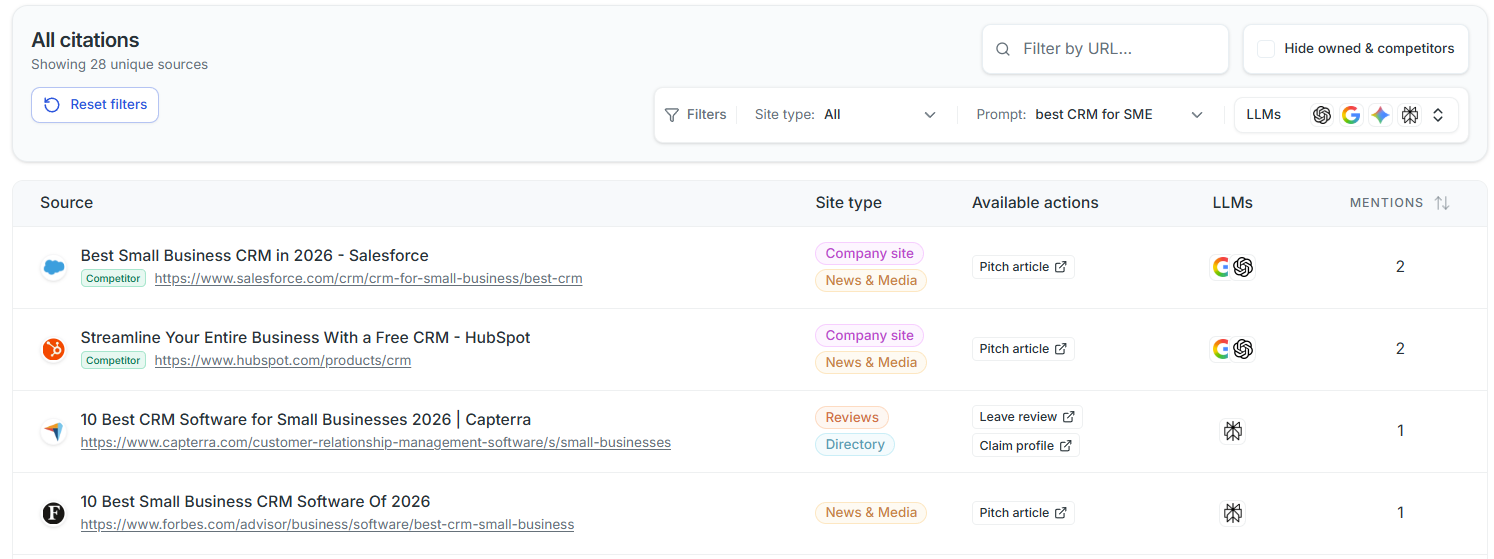
Brand Pages shows which pages of your own site are cited, how often, by which AI services and for which prompts. Open related answers for your selected period. Add a specific product or comparison URL to Content Monitor to follow its appearance in subsequent collected answers. Content Monitor accepts links to your own or external publications. Action Plan brings source opportunities, content gaps, negative themes and technical issues into practical priorities.
Tech Review checks robot access, robots.txt, sitemaps, llms.txt, content available in HTML, structure, semantics, metadata and company information. Review its overall score, scores by area, identified problems, recommendations and change history. Export citation records in CSV or Excel for the next review. Ask the project chat a follow-up question, save, archive and continue the conversation when new answers arrive. Pro’s MCP access also lets an external agent compare periods and retrieve supporting project records.
This gives the team a clear sequence: inspect the placement, read the recommendation, check its evidence and assign the next action. Ads Radar reports observed placements. Your team manages any advertising campaigns separately.
Investigate Reddit, YouTube and review sources
SupaIntent gives you dedicated views of the communities, videos and review pages cited in AI answers. Use them to identify the discussions and publishers your team should read before choosing where to contribute, update information or explain your product.
Reddit Radar: find the conversations AI draws on
See the most-cited communities and discussions, how often they appear, which AI services cite them and which brands appear in the associated answers. Reddit Radar also separates external sources that explicitly mention Reddit. Your team can follow a recurring concern to a specific discussion and decide whether it deserves attention.
YouTube Radar: identify the videos behind recommendations
Find leading cited channels and videos, with citation frequency and the share of collected answers that cite YouTube. Inspect available publication dates, duration, views, likes, comments and channel subscriber counts. These details help your team assess the cited material and choose which product explanation or demonstration to investigate.
Review Radar: inspect the pages shaping the shortlist
Explore cited sources from platforms such as G2, Trustpilot, Capterra, Clutch, Gartner Peer Insights and Tripadvisor. Review Radar ranks platforms by citation frequency and brands by their presence in answers containing review-platform links. Inspect specific pages, separated into profiles, categories, comparisons, reviews and complaints, then open the supporting AI answers. This gives your team a concrete source to assess when reviewing its positioning or reputation.
Choose SupaIntent
Choose SupaIntent Pro to investigate detected ads alongside products and places, topic sentiment, cited sources and technical issues. For a program within 150 prompts, its $299/month plan also gives you the lower monthly brand-plan entry for Ads Radar in this comparison.
Sources and scope
Checked in September 2026. Sources: Citeme for monitoring and monthly brand plans, Orchly for Business Ads Radar, and That Marketing Buddy for MCP tool scope. We also checked the current brand pricing matrix directly.
This SupaIntent-authored comparison covers published monthly brand subscriptions, excluding agency plans, annual discounts, taxes and custom agreements. Review publishers have commercial interests. Our product claims cover customer capabilities, excluding Beta and internal tools; Ads Radar and MCP require Pro. The example is illustrative, and the comparison does not measure accuracy, ad sales or business outcomes.

[ get started ]
Make AI Search your next revenue channel
Track and optimize visibility in ChatGPT, Gemini and other AI Search engines to drive traffic to your website that converts.